


Referral program: the complete guide for online stores (2026)

- Use a two-sided reward, and pay the referrer only after the friend's first order is confirmed and can no longer be returned.
- Keep the friend's discount plus the referrer's reward below the gross profit of a first order, and below what ads cost you per new customer.
- Pre-write the share message, ask right after a good experience, and set anti-fraud rules and terms before launch.
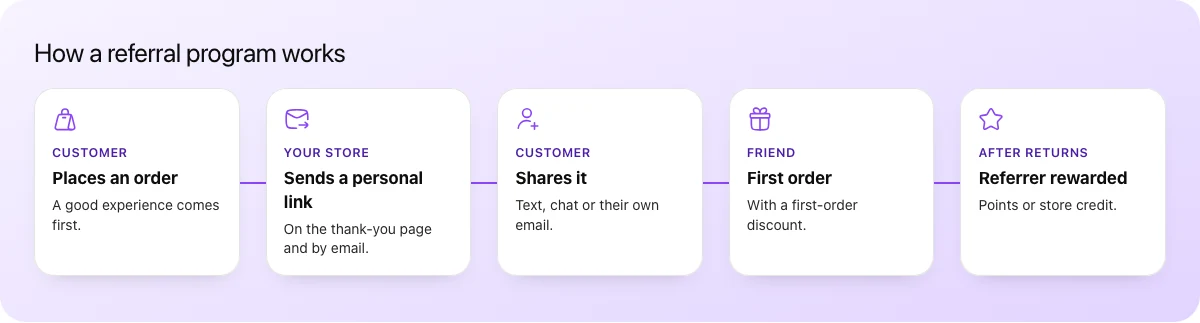
A referral program pays your customers to do what happy customers already do: recommend you. A customer shares a link, a friend gets a reason to place a first order, and the customer earns a reward once that order is real. Done well, it is one of the few acquisition channels where you pay only after a sale. Done badly, it becomes a discount code that ends up on coupon sites.
This guide covers what most referral guides skip: how much a referral is worth paying, which reward fits your store, messages you can paste, the fraud and legal rules, and the setup on Shopify. It belongs to our ecommerce loyalty program guide, which covers points and VIP tiers.
What is a referral program, and when does it work?
A referral program, also called a refer-a-friend program, is a set of rules that rewards existing customers for bringing in new ones. Every program has the same four parts:
- A unique link or code per customer, so each new order can be traced to the person who sent it.
- A friend offer, usually a first-order discount or free shipping.
- A referrer reward, paid once the friend's order is confirmed.
- Rules on who qualifies, when rewards are paid and what cancels them.
A loyalty program rewards a customer's own repeat orders. A referral program rewards them for someone else's first order. That is why referrals still work for products people buy rarely, such as a mattress or a bike, where points would rarely be spent.
What research says about referred customers
A widely cited study followed about 10,000 customers of a German bank for almost three years. Referred customers had a higher contribution margin and a higher retention rate than similar customers acquired in other ways:
Two caveats: it is one bank, not an online store, and the gap varied by customer segment. Treat it as a reason to measure your own referred customers, as shown in the last section. For the other retention levers, see our guide to customer retention strategies.
When a referral program is the wrong tool
- Nobody talks about the product yet. A reward amplifies word of mouth; it rarely creates it. Fix the product or the delivery experience first.
- Your margin cannot fund a first-order discount. The math section shows how to check.
- The purchase is private. People do not share links for some products, whatever the reward.
Referral rewards: how to choose the incentive
One-sided or two-sided rewards
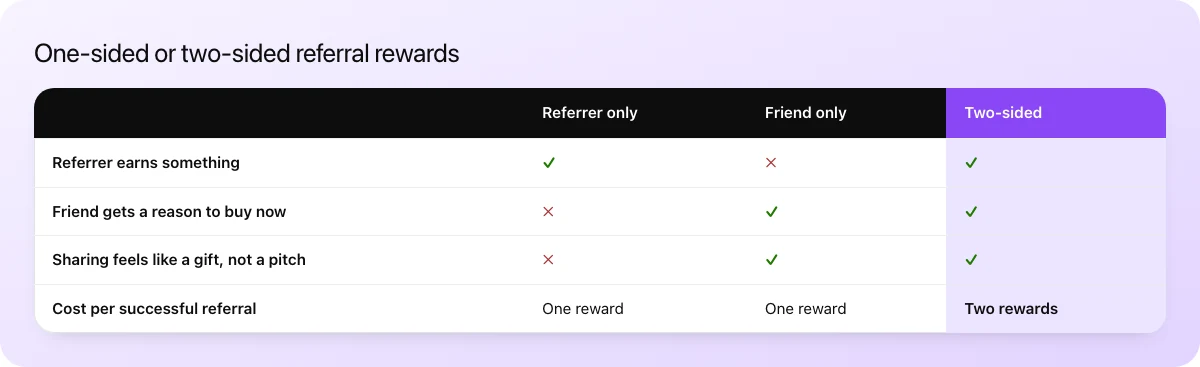
A two-sided reward gives both people something: the friend gets a discount, the referrer gets points or credit. The referrer is not selling to a friend; they are passing on a gift, and they get thanked for it.
The friend's offer
Keep it simple: a first-order discount or free shipping. Prefer a fixed amount with a minimum order, such as "$10 off orders over $40", to a percentage. The cost stays predictable, and the code cannot take $10 off a $12 item.
The referrer's reward
This side depends on how your customers buy. A tick means the reward fits that situation.
| Your situation | Points | Discount code | Store credit | Free product | Cash or third-party gift card |
|---|---|---|---|---|---|
| You already run a points program | ✓ | ✗ | ✗ | ✗ | ✗ |
| Customers reorder every few months | ✓ | ✓ | ✓ | ✓ | ✗ |
| Customers buy once every few years | ✗ | ✗ | ✗ | ✗ | ✓ |
| Thin margins | ✓ | ✗ | ✗ | ✓ | ✗ |
| You have a high-margin product or a sample size | ✗ | ✗ | ✗ | ✓ | ✗ |
| You want the reward to bring the referrer back | ✓ | ✓ | ✓ | ✓ | ✗ |
Points or store credit have a hidden advantage: they can only be spent in your store, so the reward usually comes back as another order from the referrer. Cash and third-party gift cards make sense only when customers will not buy again soon, and they are harder to run.

Referral program ideas beyond "give $10, get $10"
Most programs use a standard structure: the same reward for every referral. The best-known example is Dropbox, where both people get extra storage, 500 MB per referral on a Basic account, up to 16 GB. The reward is the product itself, so it costs little and brings the referrer back. Variations on that idea:
- Double rewards for two weeks around a launch: urgency without raising costs for good.
- A tiered reward: a bigger one at the third successful referral, for the few customers who refer a lot.
- A charity option that turns the reward into a donation, for mission-driven brands.
Check which of these your app supports before you announce them.
Referral program math: what a new customer is worth paying
"Generous but affordable" is not a number. These two rules are:
- Payback rule: the friend's discount plus the referrer's reward stays below the gross profit of the friend's first order. Every referral then pays for itself on day one.
- Ceiling rule: the same total stays below what you pay to win a new customer with ads. Above that, ads are cheaper.
Here is a worked example for an illustrative store. Replace each line with your own numbers.
| Line | Example | Where to find yours |
|---|---|---|
| Friend's first order | $60 | Average order value of first-time customers in Shopify Analytics |
| Gross margin | 55% | Price minus product cost, shipping and payment fees |
| Gross profit on the first order | $33 | $60 × 55% |
| Friend's discount | −$10 | Your offer, with a $40 minimum order |
| Referrer's reward | −$10 | 200 points worth 5 cents each, counted when redeemed |
| Profit left on the first order | $13 | $33 − $10 − $10 |
| Extra orders in the next 12 months | 0.8 | Repeat rate of your first-time buyers |
| 12-month gross profit per referred customer | $39.40 | $13 + 0.8 × $33 |
Three things stand out. The rewards look generous at $20 in total, but they stay under the $33 of first-order profit, so the payback rule holds. If your ads cost $35 per new buyer, each referral is cheaper, and shares that never convert cost nothing. Finally, the repeat line carries most of the value. If referred customers reorder more often, as the bank study suggests, the program is worth more than the first order shows. Measure that before you raise rewards.
When and where to ask customers for referrals
People recommend you right after a good experience, not on your schedule. Put the ask at these moments:
| Moment | Channel | Why it works |
|---|---|---|
| Order confirmation | Thank-you page | Excitement peaks right after buying |
| A few days after the order | Post-purchase email | The customer has started using the product |
| Just after a positive review | Review thank-you email | They have just said they like you |
| When a reward is redeemed | Loyalty widget or email | They have just seen the program pay out |
| In the box | Printed insert with a QR code | Reaches customers who skip emails |
Our post-purchase email guide shows where the ask fits in that sequence. Asking after a review is easy to automate if your reviews and emails share the same customer data, as they do in Trio's product reviews module. For timing and triggers, see our guide to Shopify email automation.
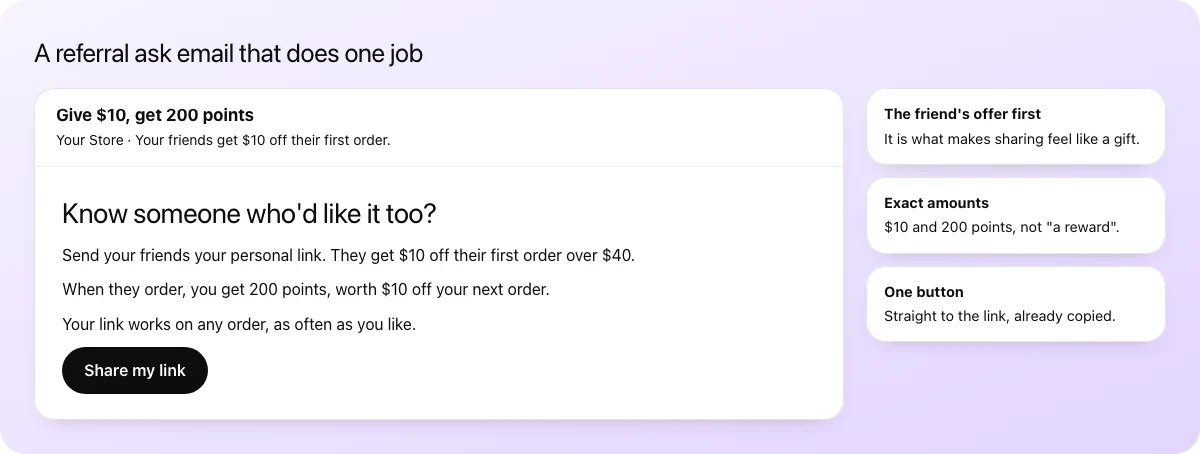
Lead with the friend's offer, name exact amounts, give one button. The slider shows the same ask written vaguely, then specifically.
Liked your Linen Throw? Your friends get $10 off their first order over $40.
You get 200 points when they order, enough for $10 off your next one.
Copy my linkShare the love! Invite your friends and earn great rewards when they shop with us.
Refer nowCopy-ready referral messages and email templates
Customers share faster when the message is already written. Pre-fill the text behind the share button, and write it in the customer's voice, not your brand's. Replace the {braces} with your own values.
- Share text
I order from {store} and really like it. Here's {friend_reward} off your first order: {link}
- Share text
This is the {product} I told you about. {friend_reward} off with my link: {link} (I get a small reward too.)
- Email subject
Give {friend_reward}, get {referrer_reward}
- Email subject
Know someone who'd like {product}?
- Ask email
Thanks for your order, {first_name}. If a friend would like {product} too, send them your link: they get {friend_reward} off their first order, and you get {referrer_reward} when they order.
- Friend page
{referrer_name} sent you {friend_reward} off your first order. Your discount is applied at checkout.
- Thank-you
A friend just placed a first order with your link. {referrer_reward} will be added to your account once the return window closes.
- Terms
Rewards are paid after your friend's first order is confirmed and the return window has closed.
- Terms
The friend's discount applies to a first order from a new customer, on orders over {minimum}.
- Terms
You cannot refer yourself. Refunded or cancelled orders do not earn a reward.
- Terms
Rewards are limited to {cap} successful referrals per month. We may change or end the program with notice.
- Disclosure
I get a reward if you order with my link.
The thank-you message says "a friend", not the friend's name or what they bought: that order is the friend's business. The share texts mention the reward, which covers the disclosure point below. If you send emails with Trio, its email marketing library includes ready-made referral templates you can adapt.
Referral fraud, terms and compliance
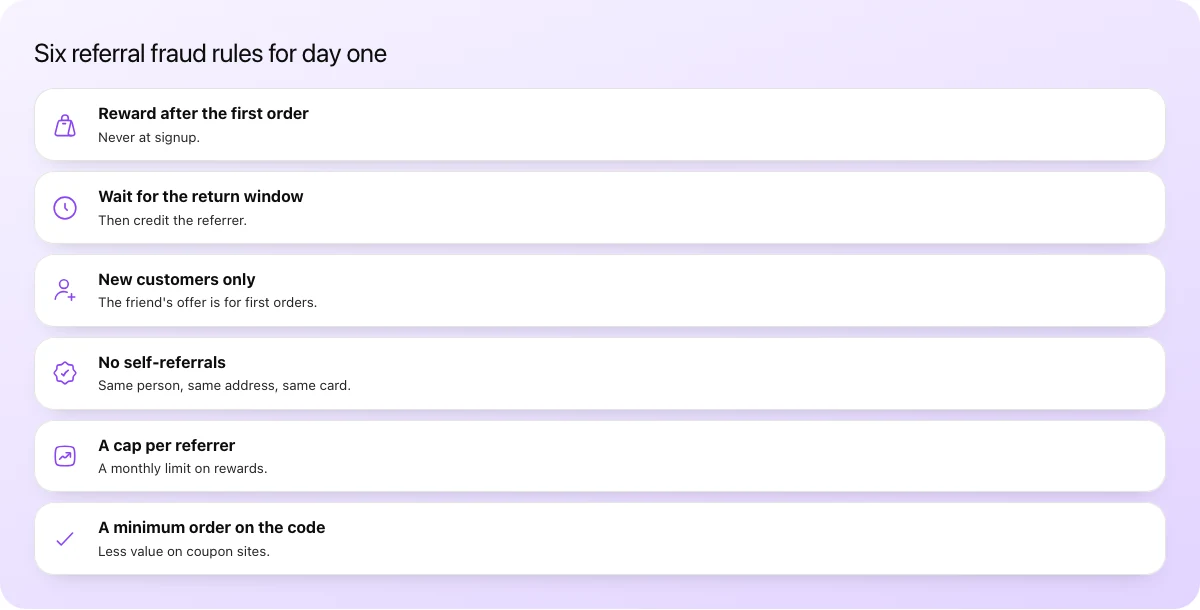
Abuse is rare in small programs, but it follows predictable patterns: a second email address used to refer yourself, a code posted on coupon sites, an order placed for the reward and then returned. Set the rules before the first customer joins.
Publish short terms
Put a terms block on the referral page. The [Terms] lines in the templates above cover the essentials: when rewards are paid, who qualifies, what cancels a reward, the monthly cap and how changes are announced. Clear terms settle most disputes before they start.
Two compliance points most guides miss
- Disclosure when customers post their link: A customer who posts a referral link on social media earns something from it. The FTC's Endorsement Guides FAQ expects people who earn from their links to disclose the relationship clearly, with sample wording such as "I get commissions for purchases made through links in this post." Put a short disclosure in your pre-filled share text.
- "Enter your friend's email" forms: If your store sends the invitation and rewards the referrer for it, the FTC's CAN-SPAM compliance guide says the seller may be responsible for that message, including a postal address and a working opt-out. Letting customers share their own link by text, chat or their own email avoids the problem. Privacy rules outside the US can be stricter.
Finally, decide whether the friend's code can combine with your sales. Shopify only combines discounts when each one allows it, and a customer can use at most five product or order codes plus one shipping code per order, according to Shopify's help page on combining discounts.
How to set up a referral program on Shopify
The Shopify admin gives you discount codes but no refer-a-friend program with tracked links and automatic rewards. Shopify's own affiliate program is something else: it pays people who refer new merchants to Shopify. You have two options.
Option 1: by hand, for a first test
- In the Shopify admin, open Discounts and create an "Amount off order" code for each referrer, such as ANNA10, with a minimum purchase and "Limit to one use per customer".
- Send each referrer their code and the share text from the templates above.
- Check each code's usage every week and reward the referrer yourself, with store credit or a code of their own.
It works for 20 referrers, breaks at 200 and cannot stop self-referrals.
Option 2: a referral or loyalty app
An app creates a link per customer, applies the friend's discount, tracks the order and pays the referrer automatically, often only on certain plans. Here is the lowest plan with referrals in popular Shopify apps, from each app's Shopify App Store listing and pricing page, checked on November 25, 2026. Trio is our product.
| App | Lowest plan with referrals | Price per month | Plan limit |
|---|---|---|---|
| Smile.io | Free | $0 | Up to 200 monthly orders |
| Joy Loyalty | Starter | $0 | 250 monthly orders |
| Yotpo Loyalty & Referrals | Free | $0 | Under 100 monthly orders on the App Store (yotpo.com shows a higher limit) |
| Growave | Entry | $15 | 500 monthly orders, then $20 per 100 |
| Judge.me | Awesome | $15 | Flat price; referrals tied to reviews, no points program |
| Rivo | Scale | $49 | 400 orders, then $20 per 100, capped at $499 |
| Loox | Convert | $49.99 | 300 orders, then $50 per 300 |
| Okendo | Referrals add-on | On request | Flat monthly fee by order volume |
| Trio (our app) | Growth | $79 | 5,000 email contacts, unlimited loyalty members |
Smile.io, Joy and Yotpo include referrals for free, Joy and Growave advertise referral fraud prevention, and Judge.me's flat $15 plan suits a store that mainly wants reviews. Trio's referrals start higher, on Growth at $79 a month, because that plan bundles product reviews, email marketing and loyalty, priced by the size of your contact list rather than by orders. If referrals are all you need and you take fewer than 200 orders a month, a free plan elsewhere will do the job. For the full picture, see our comparison of Shopify loyalty programs and our ranking of the best loyalty program software.
Set it up in Trio
In Trio, referrals are part of the loyalty and rewards module on Growth and up: the friend gets a discount (a percentage, a fixed amount or free shipping), and the referrer earns the points you set. Each member's referral link appears in the storefront loyalty widget, and on Shopify Plus stores a referral code can also be entered in checkout. Plan details are on the pricing page.
Two limits to know against the fraud rules above. Trio blocks self-referrals by comparing email addresses, including +aliases, but not postal addresses or cards. And it credits the referrer as soon as the friend's order is paid: it does not wait for your return window, and a later refund does not yet take the referral points back. Until it does, check refunded orders from referred friends once a week and adjust balances by hand.
Measure and improve your referral program
Track five numbers from day one:
| Metric | How to calculate it | What it tells you |
|---|---|---|
| Participation rate | Customers who shared at least once ÷ customers who saw the offer | Whether the offer and its placement work |
| Referral conversion rate | Friends' first orders ÷ clicks on referral links | Whether the friend offer and landing page work |
| Share of new customers from referrals | Referred first orders ÷ all first orders | How much the channel matters |
| Cost per referred customer | Friend discounts + redeemed referrer rewards ÷ referred customers | How it compares with your ad cost per new buyer |
| Referred customers' repeat rate | Referred customers with a second order ÷ all referred customers | Whether referred customers are worth more for you |
Compare the last one with other first-time buyers from the same period: it is the bank study's test, run on your store.
When a number disappoints, change one thing at a time and give it a month:
- Few shares: move the ask closer to the purchase, rewrite the share text and show the friend's reward first.
- Clicks but few orders: the friend's offer is too weak, or the code does not apply on its own at checkout.
- Volume is fine, margin is not: lower the referrer reward or switch it to points, and keep the friend's offer.
- A sudden spike: search for your code on coupon sites, then add a cap or a higher minimum order.
Start small: one two-sided offer that passes the payback rule, a pre-written share message, an ask on the thank-you page and in your post-purchase email, and fraud rules from day one. Then let the repeat rate of referred customers tell you whether to raise the reward.
Frequently asked questions
- What is a referral program?
- A referral program rewards existing customers for bringing in new ones. Each customer gets a unique link or code, the friend gets an offer on a first order, and the customer earns a reward once that order is confirmed.
- What is a good reward for a referral program?
- For most online stores, a fixed first-order discount for the friend, such as $10 off orders over $40, and points or store credit for the referrer. Keep both rewards together below the gross profit of an average first order, so every referral pays for itself.
- Should both the referrer and the friend get a reward?
- Usually, yes. A two-sided reward gives the friend a reason to buy now and makes sharing feel like passing on a gift rather than selling. Referrer-only programs are cheaper per referral but give the friend no reason to act.
- Does Shopify have a built-in referral program?
- The Shopify admin lets you create discount codes but has no refer-a-friend program with tracked links and automatic rewards. Stores add one with a referral or loyalty app. Shopify's own affiliate program is a different thing, aimed at people who refer new merchants to Shopify.
- How do I set up a referral program on Shopify?
- For a small test, create one discount code per referrer in Shopify and credit referrers by hand. For anything larger, install a referral or loyalty app that creates a link per customer, applies the friend's discount and pays the referrer automatically.
- How do I prevent referral fraud?
- Pay the referrer only after the friend's first order is confirmed and past your return window, limit the friend's offer to new customers, block self-referrals, cap rewards per referrer and use a minimum order on the friend's code so it is not worth posting on coupon sites.
- Do I need terms and conditions for a referral program?
- Yes. Publish a short block that says who qualifies, when rewards are paid, what cancels a reward, any cap per month and that you can change or end the program with notice. Clear terms prevent most disputes before they start.
- What is the difference between a referral program and an affiliate program?
- A referral program rewards customers for recommending you to people they know, usually with discounts or points. An affiliate program pays creators or publishers a commission for sales from their audience. Affiliates are partners; referrers are customers.
- When should I ask customers for referrals?
- Right after a good experience. Good moments are the order confirmation page, a post-purchase email a few days after the order, just after a customer leaves a positive review and when they redeem a reward.
- How do I measure a referral program's success?
- Track participation rate, referral conversion rate, the share of new customers that come from referrals, the cost per referred customer and the repeat rate of referred customers compared with other new customers.