


Ecommerce loyalty program: types, rewards and a strategy that pays off

- Pick the program type from how often people buy: points for frequent orders, tiers for a clear group of top buyers, referrals when purchases are rare.
- Price every reward at what it costs you, not its face value, and put the first reward within two or three orders.
- Connect points to your emails and reviews, then judge the program on repeat purchase rate against a fair baseline.
An ecommerce loyalty program rewards customers for coming back: points on every order, perks for your best customers, a discount for bringing a friend. The idea fits in one sentence. The execution is where stores go wrong. Rewards get priced on a hunch, the widget sits in a corner, and the program never appears in the emails and reviews that customers actually read.
This guide is the hub of our loyalty series. It covers the program types and when each one fits, how to price rewards from your margin, a 30-day launch plan on Shopify, the metrics that show whether it works, and how to choose software. Each section points to a deeper guide when you need one.
What an ecommerce loyalty program does (and when you need one)
A loyalty program is not a discount with a logo on it. It has three jobs, and a good program is designed around them:
- Win the second order. A first-time buyer has no habit with your store. A visible balance and a reward that is close give them a concrete reason to return.
- Raise purchase frequency. Customers who already like you buy a little more often when each order moves them toward something.
- Make switching cost something. When a competitor sells a similar product for less, a balance the customer would lose is a reason to stay.
The economic case for retention is old and widely quoted. The two figures you see everywhere come from the same article:
Read them as a direction, not a forecast. The article itself says the acquisition figure depends on which study you believe and on your industry. Your own numbers matter more, and the math section below shows how to get them.
When a loyalty program is the wrong tool
- You sell a once-in-years product, such as a mattress or a wedding dress. Points will rarely be redeemed, so a referral reward fits better.
- Nobody reorders yet. If almost no customer buys twice, fix the product, the delivery experience and the post-purchase emails first. A program amplifies loyalty that exists; it rarely creates it from nothing.
- Your margin cannot fund even a small reward. Use perks that cost little, such as early access, instead of points.
A loyalty program is one lever among several. For the others, see our guide to customer retention strategies for online stores.
Types of ecommerce loyalty programs, and which one fits your store
Most programs are built from six building blocks. You can combine them later, but start with one or two.
Points programs
Customers earn points for each dollar spent and for actions such as a review or a birthday, then trade them for rewards. Points work best when people buy often enough to watch the balance grow: coffee, skincare, pet food, supplements. They are the easiest type to explain and the usual starting point.
VIP tiers
Customers move up levels, such as Bronze, Silver and Gold, as they earn points, and each level unlocks better perks. Tiers reward your top customers without raising the discount for everyone. They only make sense once you have a visible group of repeat buyers.
Referral programs
A customer shares a link, the friend gets a discount on a first order, and the customer gets a reward once the friend buys. Referrals work even when people buy rarely, because the value comes from new customers rather than repeat orders.
Cashback and store credit
A share of each order comes back as credit to spend in your store. "5% back" is easy to understand and keeps the money in your shop. It is also a pure discount on every order, so price it carefully.
Paid memberships
Customers pay a fee for ongoing perks, such as free shipping or member prices. They can lift spending, but only when the perks clearly beat the fee, and they take real work to run. Trio does not offer paid memberships; some loyalty apps, such as Joy, include them on higher plans.
Value-based and hybrid programs
Value-based programs let customers turn points into a donation or support a cause. Hybrid programs combine types, most often points plus tiers plus referrals. Hybrids are powerful but harder to explain, so add one layer at a time.
Which loyalty program type fits your store
Use this matrix as a first filter. A tick means the type is a good fit for that situation.
| Your situation | Points | VIP tiers | Referrals | Cashback or credit | Paid membership |
|---|---|---|---|---|---|
| Frequent, low-ticket orders (coffee, skincare, pet food) | ✓ | later | ✓ | ✓ | ✓ |
| Rare, high-ticket orders (furniture, bikes) | ✗ | ✗ | ✓ | ✗ | ✗ |
| A small group of heavy buyers drives revenue | ✓ | ✓ | optional | ✗ | ✓ |
| Thin margins | ✓ | ✗ | ✓ | ✗ | ✗ |
| Customers love to talk about the brand | optional | ✗ | ✓ | ✗ | ✗ |
| You want a rule you can explain in one sentence | ✓ | ✗ | ✓ | ✓ | ✗ |
Points still work with thin margins if the rewards are cheap to fulfil, such as samples or free shipping, and a referral reward is only paid when a new customer buys. If you are unsure, start with points and referrals, then add tiers once you can name your top customers. Repeat buying varies a lot by vertical; our breakdown of how retention differs by industry helps you set expectations for yours.
Three example programs for three kinds of store
The matrix becomes concrete once you plug in a basket size and a buying rhythm. These stores are illustrative, not clients:
- A coffee roaster, $35 baskets every five weeks: 1 point per $1, $5 off at 100 points, so the first reward lands on the third order. A referral gives the friend $10 off. No tiers in year one.
- A furniture store, $900 orders once every few years: no points at all. The friend gets $50 off a first order, and the referrer gets $50 of store credit once that order is past your return window.
- A skincare brand where a fifth of customers place most orders: points plus three tiers on a rolling 12 months, with free shipping and early access at the top instead of deeper discounts.
Each one follows the same logic: the reward appears where the customer's next purchase realistically happens.
Loyalty rewards: what to offer and what each costs you
The reward menu decides two things: whether customers care, and whether you can afford it. The rule that keeps programs healthy is to price rewards at cost, not face value. A free product with a $25 price tag may cost you $8 to give away. A $5 discount costs exactly $5.
| Reward | Real cost to you | Works best when | Watch out for |
|---|---|---|---|
| Fixed amount off ($5, $10) | Face value | You want a simple, readable ladder | Set a minimum order so $5 off a $6 item is impossible |
| Percentage off | A share of the order, whatever its size | Basket sizes vary a lot | It grows with the basket and can stack with sales |
| Free shipping | Your average label cost | Shipping fees make customers hesitate | Shopify accepts one shipping discount per order |
| Free product | Product cost, not retail price | You have a high-margin product or a sample size | Stock levels and size variants |
| Store credit | Face value, spent in your store | You want the reward to come back as an order | Clear terms on how long it lasts |
| Early access or exclusive drops | Close to zero | You release limited products or collections | The perk must be real, not a label |
Most loyalty apps turn a redemption into a Shopify discount code, so Shopify's discount rules apply. Shopify applies product discounts first, then order discounts, then shipping discounts, and an order can carry up to five product or order codes plus one shipping code. Before launch, decide whether a reward code may combine with your sitewide sales. The Shopify Help Center page on combining discounts lists what can stack and which stores are eligible.
Three or four rewards are enough at launch. A long menu makes people think instead of buy.
The math: set your points rate from your margin
Every reward has an effective rate: what it costs you, divided by what the customer spent to earn it.
Effective reward rate = real cost of the reward ÷ spend needed to earn it
Here is a worked example for an illustrative store: average order $60, gross margin 55%, one point per dollar spent.
| Reward | Points | Spend to earn it | Real cost to you | Effective rate |
|---|---|---|---|---|
| $5 off | 100 | $100 | $5 | 5.0% |
| Free shipping | 150 | $150 | $7 (average label) | 4.7% |
| Free product ($25 retail) | 300 | $300 | $8 (product cost) | 2.7% |
| $20 off | 500 | $500 | $20 | 4.0% |
Three things stand out. The $5 reward is the most expensive per dollar, and that is fine: it is the one that brings the second order. The free product looks generous at $25 but costs less than any discount. And no reward goes above 5%, so even if every point were redeemed, member orders would still carry a gross margin of about 50%.
Put the first reward within two or three orders
The rate matters less than the distance to the first reward. Customers stop paying attention when it looks far away. Divide the first reward's price in points by the points an average order earns. At $60 an order and one point per dollar, 100 points is reached on the second order. Place the first reward within two or three orders, then space the later ones further apart.
Plan for full redemption and treat breakage as a buffer
Breakage is the share of points that are never redeemed. Some programs count on it to stay profitable. Do not. Price the program as if every point will be spent, and treat whatever goes unredeemed as a safety margin. A program that only works because people forget their points is a program people learn to ignore.
Track outstanding points as a liability, too: outstanding points multiplied by the cost of a point. With 2,000 members holding an average of 80 unspent points worth 5 cents each, $8,000 of rewards could be claimed at any time. Expiry reduces that number but frustrates customers, so always remind people before points lapse. Ask your accountant how to record it.
A starting range by margin
These ranges are our editorial starting points, not an industry benchmark. Adjust them to your own numbers:
- Gross margin under 30%: keep the effective rate near 1-2% and lean on free shipping, samples and early access.
- Gross margin from 30% to 60%: 2-5% is workable for most stores.
- Gross margin above 60%: you can go higher, but a closer first reward usually beats a bigger one.
Try it with your own numbers. The simulator shows a year of points for one customer with the example rewards above.
Then compare the yearly cost per member with what you pay to win a new customer. In the example, a customer who orders four times a year spends $240 and can claim, at most, about $12 of rewards. If your ads cost more than that per new buyer, keeping the customers you have is the cheaper trade.
VIP tiers and referral rewards: when to add them
VIP tiers
Add tiers when you can see a distinct group of top customers, usually a few months after launch. Three tiers are enough. Make the first one reachable for most repeat buyers and the top one for your best few.
Base tiers on points earned over a rolling 12 months rather than all-time totals. Status stays earned, lapsed customers drift down, and the tier reflects how people buy now. Perks that cost you little work best: point multipliers, early access, free shipping, a birthday bonus. Avoid deep discounts at the top, since your best customers already buy at full price.
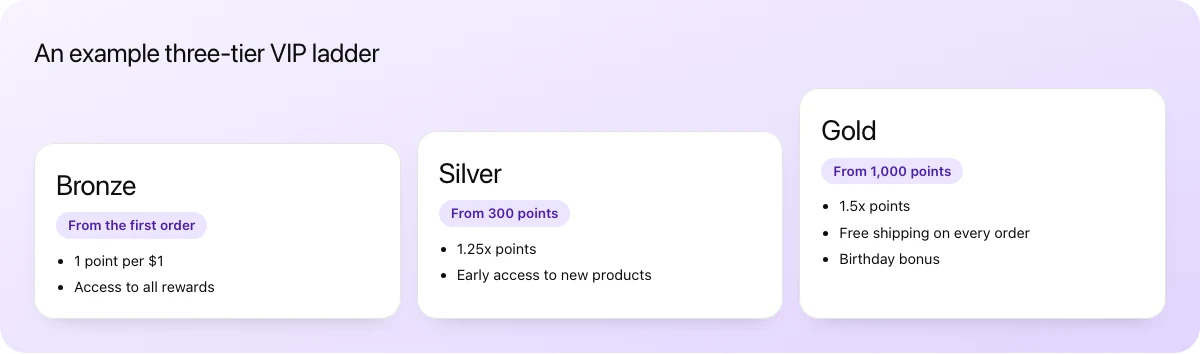
In Trio, VIP tiers start on the Growth plan. They use point thresholds you set, calculated from lifetime points, the current balance, a rolling 12 months or the calendar year, with an optional point multiplier per tier.
Referral programs
A referral reward pays for a brand-new customer, so it can be more generous than a points reward. The usual two-sided structure:
- The friend gets a discount on a first order.
- The referrer gets points or credit after the friend actually orders, not at signup.
- The referrer cannot use their own link, and points come back out if the friend's order is refunded.
Our step-by-step referral program guide covers reward sizes, sharing and wording. In Trio, the referral program is on Growth and up: the friend gets a discount, the referrer earns points, and self-referral is blocked.
How to launch a loyalty program on Shopify in 30 days
The Shopify admin has no built-in points program, so you add one with an app from the Shopify App Store. The work is mostly decisions, not setup. Here is a plan that fits in a month.
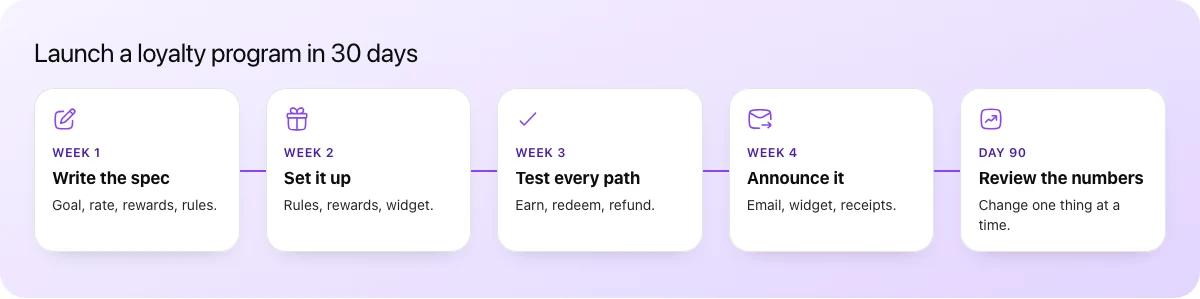
Week 1: write the program on one page
Fill in this spec before you open any app. It forces the decisions most programs skip.
| Field | Example (replace with yours) |
|---|---|
| Goal | More customers place a second order within 90 days |
| Main metric | Repeat purchase rate |
| Earning rate | 1 point per $1 spent |
| Bonus actions | 50 points for a review, 100 points on your birthday |
| Rewards | $5 off at 100 points, free shipping at 150, a free product at 300 |
| Tiers | None at launch, revisit at day 90 |
| Referral | Friend gets $10 off a first order, referrer gets 200 points after it |
| Expiry | Points expire after 12 months without activity, with a reminder first |
| Abuse rules | Points removed on refunds, one review credit per product |
| Review dates | Day 30, day 60, day 90 |
Then write the rule a customer will read on the widget. If it does not fit in one sentence, simplify the program:
Earn 1 point for every $1 you spend. 100 points = $5 off. Bonus points for reviews and on your birthday.
A one-sentence rule is the best test of a program's design. If your team cannot say it from memory, customers will not remember it either.
Week 2: set it up in your app
Most Shopify loyalty apps follow the same order:
- Set the earning rules: points per dollar and any bonus actions.
- Create the rewards. In most apps, each redemption creates a Shopify discount code.
- Turn on the storefront widget from the theme editor (Online Store, Themes, Customize, then App embeds).
- Add the abuse rules from your spec before anyone joins.

Week 3: test every path
Place a real low-value order, since some apps ignore Shopify test orders, and check that the points arrive. Redeem a reward and use the code at checkout. Refund the order and check that the points come back out. Open the widget on a phone. Most launch problems show up here, not in the settings.
Week 4: announce it
Tell existing customers by email, mention the program in your post-purchase emails, and put the rule on the widget. The launch email has one job: show the rule and how close the first reward is.
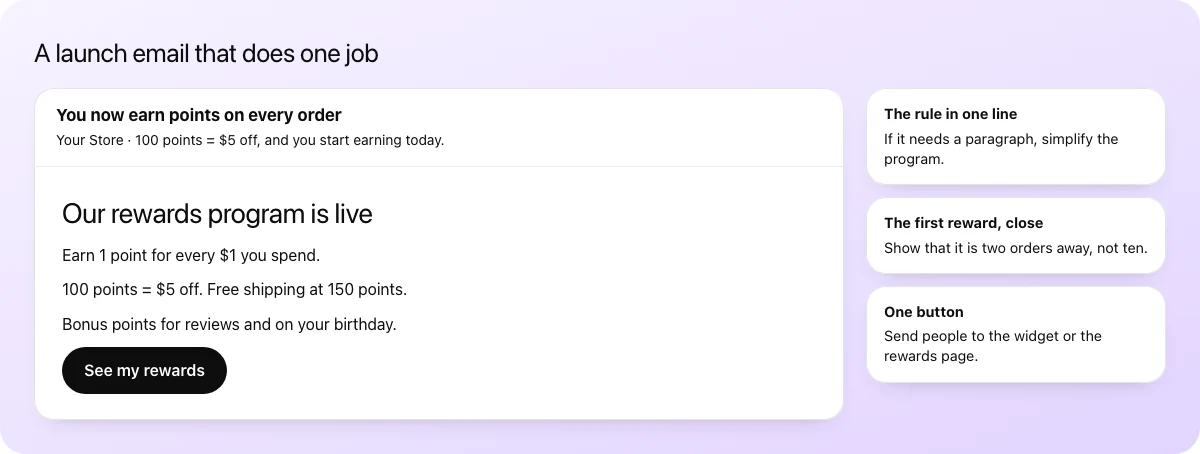
If you run the program with Trio's loyalty and rewards module, the setup takes three steps. The Free plan includes a points program with up to 3 rewards for 250 members.
Connect loyalty with reviews and email
A program that lives only in a widget gets forgotten. The ones that keep working show up where customers already pay attention: the inbox and the product page.
Reward reviews, never the rating
Points for a review are one of the best earning actions. They bring customers back to your store and give you fresh content for your product pages. The rule is strict, though: the reward must not depend on what the review says. The FTC's final rule banning fake reviews and testimonials (August 2024) bans incentives conditioned on a review expressing a particular sentiment, positive or negative. Reward every honest review the same way, and limit it to one credit per product per customer.
On paid plans, Trio emails a review request a few days after each order (7 days by default), customers can earn loyalty points for the review, and a thank-you email can go out automatically. Trio also credits review points only once per product per person. See how collection and display work in Trio's product reviews module.
Put the points balance in your emails
A balance in the inbox is a stronger nudge than a balance in a widget nobody opens. The moments that matter:
- After each order: "You just earned 60 points. 40 more and you get $5 off." Our post-purchase email guide covers the rest of that sequence.
- Before points expire: a reminder 30 days and 7 days before.
- On a tier change: congratulate the customer and say what they unlocked.
- After 30, 60 or 90 days without an order: remind lapsed customers of the balance they still have.
Every Trio email can show the customer's points balance and quotes from your reviews. On Starter and up, Trio's automations include post-purchase, win-back, points-expiry and post-review emails, plus VIP tier change emails once you use tiers on Growth. For timing and flow design, read our guide to Shopify email automation, and for the email side of the app, see email marketing in Trio.
Measure, protect and improve your rewards program
The loyalty metrics that matter
| Metric | How to calculate it | What it tells you |
|---|---|---|
| Repeat purchase rate | Customers with 2 or more orders ÷ all customers, over a period | Whether the program moves the main goal |
| Time to second order | Median days between the first and second order | Whether the first reward pulls people back sooner |
| Enrollment rate | Members ÷ customers who ordered | Whether people notice the program |
| Active member rate | Members who earned or redeemed in the last 90 days ÷ all members | Whether members still care |
| Redemption rate | Points redeemed ÷ points issued | Whether the rewards feel worth it |
| Reward cost rate | Cost of redeemed rewards ÷ revenue from members | Whether the program stays affordable |
Shopify's analytics include a returning customer rate; your loyalty app shows members, points and redemptions. For more ways to lift repeat purchases on your store, see our Shopify customer retention guide.
Compare against a fair baseline
The classic mistake is comparing members with non-members and crediting the program for the gap. Your most loyal customers join first, so members always look better. Instead, compare customers who first bought before and after launch, over the same length of time. If the second group reorders sooner and more often, the program is doing its job.
Trio follows the same caution. Its cross-module insights on Growth and up compare the average spend of groups, such as reviewers and non-reviewers, and label the result as correlation, not cause. Its attributed revenue counts orders where a loyalty reward code was used, or where the customer clicked a Trio email in the 5 days before. Trio does not track total store revenue, so read it alongside Shopify's own reports.

Protect the program from abuse
Abuse is rare in small programs and cheap to prevent. Set these rules before launch, and check which ones your app supports:
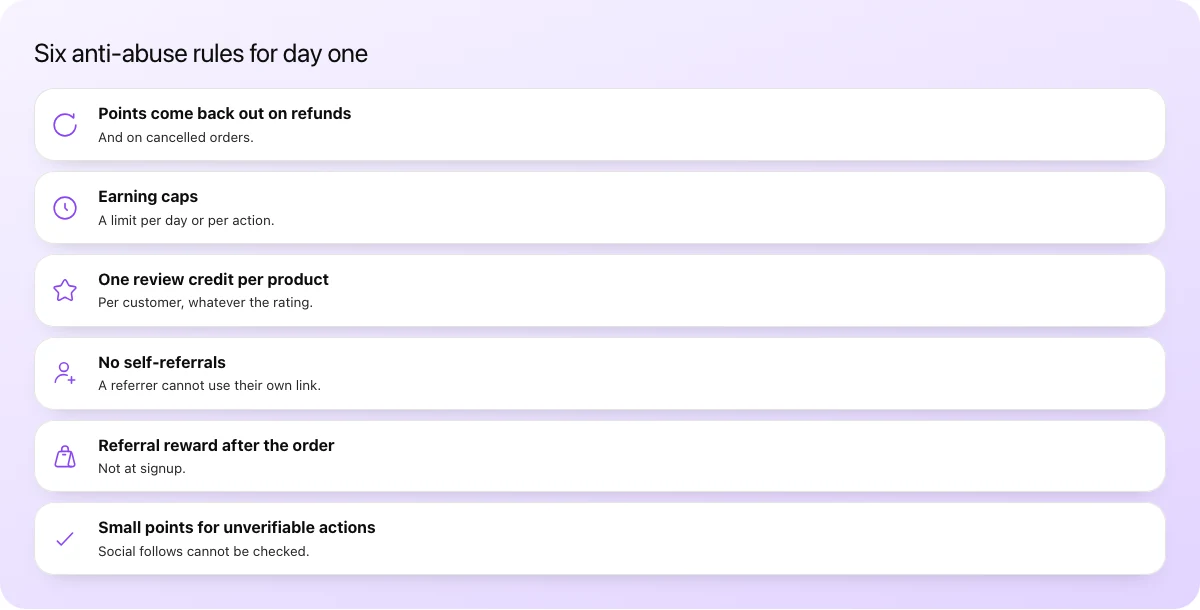
Social follows and shares are a good example of the last rule. No public API lets an app confirm that a customer followed you, which is why Trio labels those earn actions as declarative. Keep their points small.
Improve it every 90 days
At each review, look for one problem and change one thing:
- Few members reach the first reward: lower its price in points.
- Redemption is high and margin suffers: raise the price of later rewards, not the first one.
- Enrollment is low: the program is invisible, so put it in more emails and on product pages.
- Members stop earning: add a bonus event, such as double points for a weekend.
Give each change a month before you judge it. Announce changes in advance, and never cut the value of points customers already hold without notice.
Choosing loyalty program software for Shopify
Three questions narrow the choice quickly:
- How is it billed? Most loyalty apps bill by monthly order volume, so the price rises as you sell more. Model the cost at your volume a year from now, not today.
- Which features sit on which plan? VIP tiers, referrals and points expiry are often reserved for higher plans.
- What else do you need? A physical shop needs POS support. Redeeming points inside checkout depends on Shopify Plus, because Shopify limits in-checkout extensions to Plus stores; other stores redeem from the storefront widget.
Here is where the main Shopify loyalty apps put their free plan, first paid plan and VIP tiers. Figures come from each app's Shopify App Store listing and official pricing page, checked on November 25, 2026. Trio is our product, listed alongside the others.
| App | Free plan | First paid plan | VIP tiers from | Price grows with |
|---|---|---|---|---|
| Smile.io | Up to 200 monthly orders | $15/month | Growth, $199/month | Monthly orders |
| LoyaltyLion | Up to 400 monthly orders | $199/month (Classic) | Add-on on Classic, included from Advanced (quote) | Monthly orders |
| Yotpo Loyalty & Referrals | Under 100 monthly orders per the App Store (yotpo.com shows a higher limit) | From $199/month (Pro) | Premium (quote) | Monthly orders |
| Rivo | Up to 200 monthly orders | $15/month | Scale, $49/month plus $20 per 100 orders above 400 | Monthly orders |
| Joy | Up to 250 monthly orders | $29/month | Advanced, $129/month | Monthly orders |
| Growave | 200 monthly orders per the App Store (100 per its site) | $15/month | Growth, $199/month | Monthly orders |
| Trio (our app) | 250 loyalty members, 3 rewards | $29/month (Starter) | Growth, $79/month | Contact list size |
Each of these apps has real strengths. Smile.io supports Shopify POS on every plan, including Free. Smile.io, Joy and Yotpo include referrals in their free plans. LoyaltyLion lists more than 50 integrations. Rivo caps its Scale plan at $499 a month whatever your volume. Growave bundles loyalty with reviews and a wishlist.
Trio takes a different approach: product reviews, email marketing and a loyalty program in one app, priced by the size of your contact list rather than by orders, with all three modules in every plan. It is not the right fit if you need in-store loyalty, paid memberships, wallet passes or SMS, because Trio does not offer them. Compare Trio's plans and quotas, read our ranking of the best loyalty program software, or see a side-by-side comparison of Shopify loyalty programs.
Start small: one points rate, three rewards, a one-sentence rule and a review date in your calendar. Connect the program to your emails and reviews in the first month, measure it against a fair baseline, and add tiers and referrals once the basics work.
Frequently asked questions
- What is an ecommerce loyalty program?
- It is a set of rules that rewards online customers for coming back, usually with points per dollar spent that they trade for discounts, free shipping or products. Many programs add VIP tiers for top customers and a referral reward for bringing in friends.
- Are loyalty programs worth it for small online stores?
- They are worth it when customers can realistically buy again within a few months. If you sell something people buy once every few years, a referral reward usually does more. Several Shopify loyalty apps have a free plan, so you can test a program before paying for one.
- What is the best type of loyalty program for ecommerce?
- For most stores, a points program with three or four rewards, plus referrals. Add VIP tiers once you can see a distinct group of top customers, and consider a paid membership only if the perks clearly beat the fee.
- How many loyalty points per dollar should I give?
- One point per dollar is the easiest rate for customers to follow. The rate itself is cosmetic; what matters is the effective reward rate, meaning the cost of a reward divided by the spend needed to earn it. Keep that rate within your margin and make the first reward reachable within two or three orders.
- How much does a loyalty program cost to run?
- There are two costs, software and rewards. The first paid plans of the main Shopify loyalty apps ran from about $15 to $199 a month on their public pricing pages in November 2026, and most have a free plan. Reward cost is, at most, member revenue multiplied by your effective reward rate.
- Should loyalty points expire?
- It is optional. Expiry limits the rewards you owe and can bring customers back, but it frustrates people when it comes as a surprise. If you use it, pick a long window such as 12 months and send reminders before points lapse.
- Can I give loyalty points for product reviews?
- Yes, as long as the reward does not depend on what the review says. The FTC's 2024 rule on consumer reviews bans incentives conditioned on a positive or negative sentiment. Give the same points for every honest review, once per product per customer.
- Does Shopify have a built-in loyalty program?
- The Shopify admin does not include a points program. Merchants add one with an app from the Shopify App Store, which provides the storefront widget and usually turns each redemption into a Shopify discount code.
- What is the difference between a loyalty program and a referral program?
- A loyalty program rewards a customer's own repeat purchases. A referral program rewards them for bringing in new customers. Many stores run both in the same app, with the referral reward paid in points.
- How do I know if my loyalty program is working?
- Track repeat purchase rate, time to second order, active member rate and reward cost rate. Compare groups of customers who first bought before and after launch rather than members against non-members, because your most loyal customers join first.
Related articles
Ecommerce marketing automation, step by step: the 8 flows to build first, timing and exit rules, collision rules, AI and honest measurement. Read the …
November 25, 2026Email marketingEcommerce email marketing: the complete 2026 guide for Shopify storesEcommerce email marketing step by step: which flows to build first, starting schedules, copyable emails, deliverability rules and costs. Start free wi…
November 25, 2026GrowthEcommerce Retention by Industry: Complete Guide (2026)Ecommerce retention by industry: benchmarks for 7 verticals, playbooks for 12, with reorder timing, review requests and loyalty. Find your next move.
November 25, 2026