


Customer retention strategies that work: 12 plays for Shopify stores

- Diagnose before you pick. Four Shopify segments tell you whether you lose customers after order one, after a few orders, at the top or through friction.
- Each of the 12 strategies below comes with a trigger, a message you can copy and one metric to check after a full repeat window.
- Start with the second order. A first-week email, fast replies to low ratings, a timed next-order nudge and a reward reachable on order two fix the biggest leak for most stores.
Most lists of customer retention strategies give you twenty ideas and no order to try them in. This guide does the opposite. It starts with a five-minute diagnosis in your Shopify admin, then gives 12 strategies grouped by the leak they fix, each with a trigger, a message or segment you can copy and the one metric that tells you it worked. For the measurement side (cohort reports, repeat window, RFM groups), read our complete guide to Shopify customer retention alongside this one.
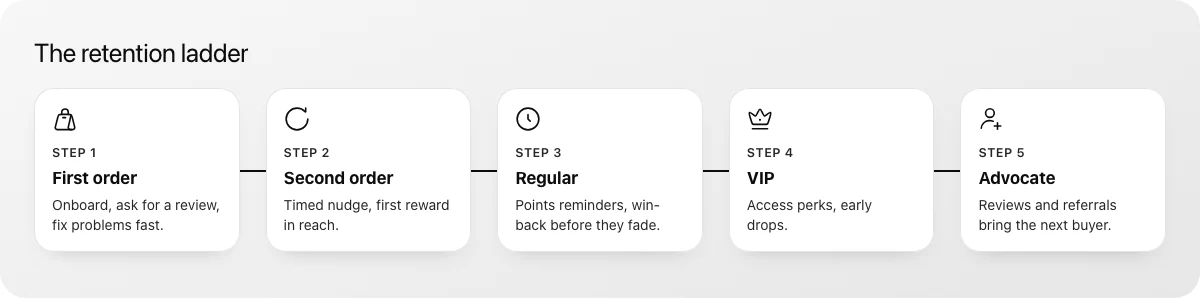
Diagnose your leak before choosing customer retention strategies
A customer retention strategy is any repeatable action that makes a past buyer more likely to order again. The trap is picking strategies by popularity. A VIP program does nothing for a store where most buyers never place a second order, and a win-back flow is wasted on customers who leave because of a sizing problem.
Shopify can show you where customers drop off. In your admin, open Customers, then Segments, then Create segment, and paste each query below. The editor counts the matching customers. The filter syntax comes from Shopify's segment filter reference.
| Leak | What it looks like | Segment to count | Start with |
|---|---|---|---|
| One and done | Many buyers, few second orders | number_of_orders = 1 | Strategies 1 to 4 |
| Slow fade | Repeat buyers who stopped | number_of_orders >= 2 AND last_order_date < -120d | Strategies 5 to 7 |
| Flat top | Best customers spend the same every year | orders_placed MATCHES (sum_amount >= 300, date >= -365d) | Strategies 8 to 10 |
| Friction | Low ratings, returns, the same complaint | Your 1 to 3 star reviews and return reasons | Strategies 11 and 12 |
Replace 120 days with about twice your repeat window, the median number of days between a customer's first and second order, and replace $300 with a spend level that fits your prices. Divide each count by your total number of customers. The biggest share is your first leak.
A worked example with invented numbers: a store has 2,400 customers. 1,560 match number_of_orders = 1 (65%), 290 match the slow-fade query (12%) and 70 match the spend query (3%), while the last 30 days brought 18 low ratings, 11 of them about sizing. The first leak is the second order, so this store starts with strategies 1 to 4 and puts the sizing fix (strategy 11) on the list for next month. It leaves VIP tiers for later: 70 customers are too few to split into tiers. Before you email any segment, add AND email_subscription_status = 'SUBSCRIBED' so you only reach people who agreed to marketing.
Strategies 1 to 4: win the second order
For most stores this is where the money is: a customer who orders twice has started a habit, while a one-time buyer is still testing you.
1. Send a first-week "use it right" email
The first week decides whether the product meets expectations. Send one email when the order has likely arrived, with three practical tips, the most common mistake and an invitation to reply. No discount, no product grid.
Subject: Before you use your {product}: 3 tips from our team Your {product} should be with you by now. Three things our regulars wish they had known on day one: {tip 1}, {tip 2}, {tip 3}. The most common mistake is {mistake}. If anything is off, reply to this email. A person reads every reply.
Watch: replies and support tickets in the first two weeks, then the cohort's second-order rate. Our post-purchase email guide has the full five-email sequence around this one.
2. Ask for a review when they can judge it, and answer every low rating
A review request does two jobs: it collects proof for the next buyer, and it surfaces unhappy customers while you can still fix things. Ask when the customer has had time to use the product, and treat every rating of two stars or less as a churn alert. Reply publicly in two or three sentences, then solve it privately: a replacement, a refund, a call.
Never tie a reward to the rating. The FTC's final rule on fake reviews bans incentives conditioned on a review expressing a particular sentiment. Copy-ready wording is in our review request email examples.
Watch: the share of low ratings answered within 24 hours, and how many of those customers order again.
3. Time a next-order nudge to the product, not the calendar
Generic "come back" emails ignore what the customer bought. Build the nudge from the first purchase instead:
- Consumables: send a refill reminder a few days before the product runs out. Supply in days minus a short buffer, counted from the order date.
- Durables: suggest the natural next item, such as filters for a coffee set or a care kit for leather boots.
- Gifts and one-offs: skip the nudge and save the effort for referrals (strategy 9).
To target buyers of a starter product who have not come back, tag the product starter-kit and save products_purchased MATCHES (tag = 'starter-kit', date >= -60d) AND number_of_orders = 1. Our retention playbooks by industry give the timing for each type of store.
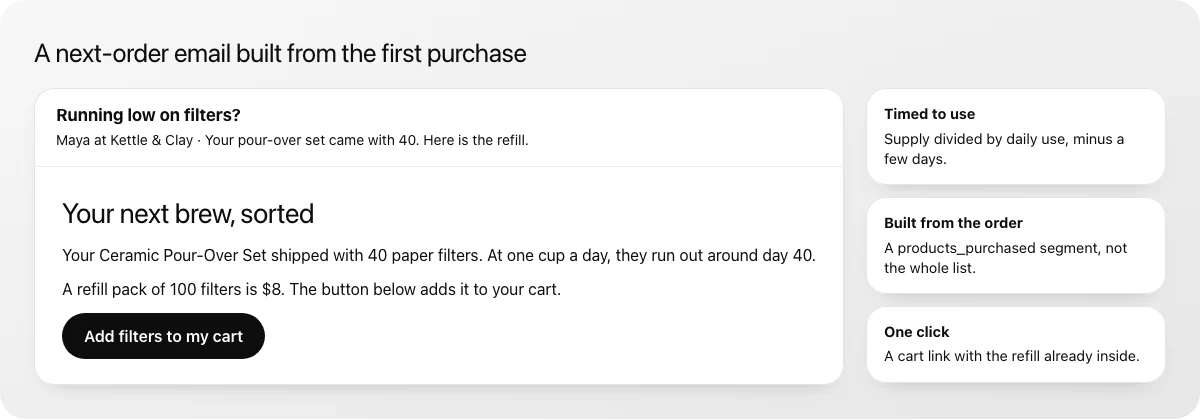
Watch: orders from that email and the median days between first and second order.
4. Put the first loyalty reward within reach of order two
A points program only pulls people back if the first reward feels close. Do the math from your average order. Example: at 1 point per $1, a $45 first order earns 45 points. With a 100-point first reward, that customer needs three orders, which is too far. Add a 50-point sign-up bonus and 25 points for a review, and the same customer has 120 points before coming back: the reward is ready to spend on order two. Now the second order has a reason.
The full method for setting rates from your margin is in our ecommerce loyalty program guide, and you can see how Trio handles points, rewards and tiers on the loyalty and rewards page.
Watch: the share of members who redeem on their second order, and the gap to the second order for members versus non-members. The comparison shows correlation, not proof.
Strategies 5 to 7: bring back customers who are fading
These customers already like you. Something interrupted the habit: a competitor, a busy month, a refill nobody reminded them about.
5. Run a staged win-back with a reason at each step
A single "We miss you, here's 15% off" at day 30 is wrong for most stores. It is too early for a product bought twice a year and too late for coffee. Base the stages on your repeat window (W):
- At 1.5 × W: a reminder with something new or useful. No discount.
- At 2 × W: one plain question. "Did something change? Reply with one word." The answers are research.
- At 3 × W: a modest offer with an end date, then stop emailing them.
Trio's win-back automation triggers after 30, 60 or 90 days of inactivity, so pick the option closest to your stages. Details on the email marketing page.
Watch: reactivation rate per stage and the discount cost per customer won back.
6. Show customers what they already have
People ignore offers but notice money they already own. An email that leads with the points balance and the reward it unlocks is specific to one person. Pair it with a reminder before points expire.
Your points cover $10 off your next order. They expire on March 31.
Your last order was the Ceramic Pour-Over Set. Filter refills start at $8.
Use my pointsCheck out what just landed in the shop.
Free shipping over $75.
Shop new arrivalsWatch: redemptions in the week after the email.
7. Treat returning customers who abandon checkout differently
A first-time shopper who abandons checkout needs reassurance: reviews, delivery times, returns. A returning customer already trusts you; they got distracted or were comparing prices. Shopify lets you isolate them with abandoned_checkout_date >= -7d AND number_of_orders >= 1. Lead with their points or a direct reply option, not your brand story.
If your tool runs one abandoned checkout flow for everyone, write it so it reads well to both groups: product first, a helpful answer second. More templates are in our abandoned cart email guide.
Watch: recovery rate for returning customers compared with first-time shoppers.
Strategies 8 to 10: grow your best customers
Your best customers do not need more discounts. They want recognition and first access.
8. Give VIPs access, not bigger discounts
Size the group first with the spend segment from the diagnosis. If your store has made more than 100 sales, Shopify's predicted_spend_tier = 'HIGH' AND number_of_orders = 1 also finds first-time buyers Shopify expects to spend more, so you can treat them well early. Then build two or three tiers on points, with perks that cost little: early access, free shipping, first pick on limited runs.
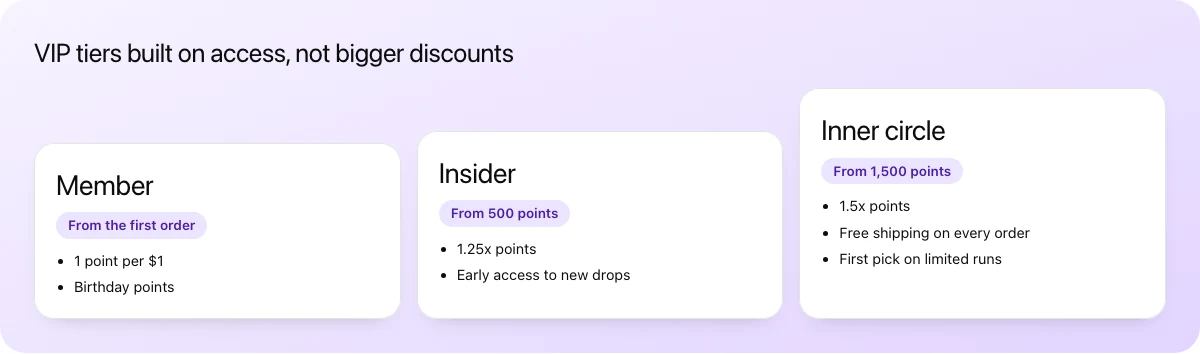
Watch: how many customers move up a tier each quarter, and how many drop.
9. Ask for referrals after a positive signal
The worst time to ask for a referral is the first checkout: the customer has not tried anything yet. Ask after a sign of satisfaction instead, such as a four- or five-star review, a third order or a kind reply to your first-week email. Keep the offer two-sided: the friend gets a discount, the referrer earns points or credit. Our referral program guide covers reward sizes and fraud rules.
Watch: the second-order rate of referred customers compared with customers from ads.
10. Turn "out of stock" into a reason to come back
A sold-out page is a customer who wanted something and left empty-handed. Collect back-in-stock requests on the page and email them the day stock returns. The customer asked for this message, so it never feels like marketing.
Watch: orders from back-in-stock emails within 48 hours of sending.
Strategies 11 and 12: remove the reasons customers leave
Some customers do not fade; they are pushed out. These two strategies cost no margin and protect every other one.
11. Fix the top complaint, then tell customers you fixed it
Once a month, read your one- to three-star reviews, return reasons and support tickets. Tag each by theme: sizing, packaging, delivery time, product quality, expectations. Fix the biggest theme at the source, then say so publicly: "You told us the sizing ran small, so we changed the size chart." Three-star reviews are the most useful because they are specific without being angry. A reviews app that lets you filter by rating makes this a 30-minute job.
Watch: the share of new reviews that mention the theme in the next quarter.
12. Send fewer, better emails, and stop emailing people who never engage
Every unwanted email teaches the inbox to file you as spam, which hurts the emails that matter. Set a sunset rule:
- No clicks in 120 days: send one "Do you still want to hear from us?" email.
- No response: stop sending campaigns to that contact.
- Measure clicks and orders, not opens. Privacy features in mail apps load images automatically, which inflates open rates.
Watch: spam complaints per send in Google Postmaster Tools, and click rate per campaign.
Which Shopify customer retention strategies to start with
Use the leak you found to pick, then this table to plan. Setup times are our estimates for a store with an email tool, a reviews app and a loyalty program already installed.
| Strategy | Leak it fixes | Setup time | Margin cost | Metric to check |
|---|---|---|---|---|
| 1. First-week email | One and done | 1 hour | None | Second-order rate of the cohort |
| 2. Review request and low-rating replies | One and done, friction | 2 hours | Low (fixes) | Low ratings answered within 24 h |
| 3. Next-order nudge | One and done | Half a day | None | Days to second order |
| 4. First reward on order two | One and done | 2 hours | Medium | Redemptions on order two |
| 5. Staged win-back | Slow fade | Half a day | Low to medium | Reactivation per stage |
| 6. Points balance reminders | Slow fade | 1 hour | Already budgeted | Redemptions after the email |
| 7. Returning-customer checkout split | Slow fade | 2 hours | None | Recovery rate, returning vs new |
| 8. VIP access tiers | Flat top | 1 day | Low | Tier moves per quarter |
| 9. Referrals after a positive signal | Flat top | Half a day | Medium | Referred customers' repeat rate |
| 10. Back-in-stock alerts | Flat top, slow fade | 1 hour | None | Orders within 48 h |
| 11. Fix the top complaint | Friction | 30 min a month | Varies | Theme mentions next quarter |
| 12. Sunset rule | Friction | 1 hour | None | Spam complaints per send |
Your size matters too. A store with 40 orders a month cannot read the results of a VIP program; there are not enough customers in each tier. Here is where we would start:
| Strategy | Under 100 orders a month | 100 to 1,000 | Over 1,000 |
|---|---|---|---|
| First-week email and review replies | ✓ | ✓ | ✓ |
| Next-order nudge | ✓ | ✓ | ✓ |
| Sunset rule | ✓ | ✓ | ✓ |
| First reward on order two | Later | ✓ | ✓ |
| Staged win-back | One email | ✓ | ✓ |
| Referrals after a positive signal | ✗ | ✓ | ✓ |
| VIP access tiers | ✗ | Maybe | ✓ |
| Returning-customer checkout split | ✗ | ✗ | ✓ |
Trio is our app, so take this part as a pitch with the limits stated: it covers strategies 1, 2, 4 to 6 and 8 to 10 in one app, the automations need a paid plan, and VIP tiers and referrals start on Growth. It does not cover strategy 3 well, because Trio segments cannot filter by purchase history, and its post-purchase and review emails are timed from the order date, not from delivery. Plans and limits are on the pricing page. For a fair look at specialist alternatives, read our ranking of the best Shopify apps for customer retention.
Shopify customer retention strategies from 2024 to 2026: what changed
If you set up your retention plan in 2024 or 2025, the tactics still hold. The rules got stricter and Shopify's targeting got better.
- Inbox rules: Google's email sender guidelines have required authentication from every sender since February 2024, and bulk senders have had to offer one-click unsubscribe since June 2024. Strategy 12 is now about deliverability, not just courtesy.
- Review rules: the FTC rule lets the agency seek civil penalties against knowing violators. Reward every genuine review the same way.
- Better segments: Shopify's editor covers RFM groups, predicted spend tier, products purchased and abandoned checkouts, so strategies 3, 7 and 8 need no spreadsheet export.
- AI drafts: many retention apps, Trio included, now draft emails and review replies. Keep a person on the approve button, especially for replies to unhappy customers.
Customer retention strategies that backfire
Some popular tactics cost more than they return:
- Discount-led retention: a code in every email trains customers to wait for the next one. Keep money-off for stage three of a win-back.
- One win-back date for everyone: day 30 annoys annual buyers and misses weekly ones.
- A first reward nobody reaches: if it takes five orders, the program is a badge, not a reason to return.
- Surveys with no follow-up: asking "how did we do?" and never acting on the answer teaches customers that feedback is ignored.
- Daily campaigns to the whole list: complaints rise, inbox placement falls, and your best automated emails suffer with the rest.
How to tell whether a retention strategy is working
Launch one strategy at a time and give it one full repeat window before you judge it. Then compare the customers who made their first order in the month before the launch with those from the month after: what share placed a second order within the same number of days? If the newer cohort does better and nothing else changed (no big sale, no new product line), keep the strategy.

Small stores should expect noise: with 50 new customers a month, two extra repeat orders look like a big swing, so judge three months together. Larger stores can keep a holdout, a random part of the segment left out of a campaign.
Attribution numbers help you compare emails with each other, not prove that retention rose. In Trio, an order counts as attributed revenue when the customer clicked a Trio email or used a loyalty reward code in the five days before ordering, with the last touch winning. That tells you which emails earn clicks that turn into orders; the cohort comparison tells you whether customers are staying.
Pick your leak, start one strategy from the matching group and put the check date in your calendar. Two strategies run well beat twelve run badly.
Frequently asked questions
- What are the most effective customer retention strategies for online stores?
- For most stores, the ones that win the second order. A useful first-week email, a review request with fast replies to low ratings, a next-order nudge timed to your repeat window and a first loyalty reward reachable on order two. In many stores one-time buyers are the largest group, so moving them up has the biggest effect. Check the share in your store with the segment number_of_orders = 1.
- How can I improve customer retention on Shopify?
- Find your biggest leak first, then start with the one or two strategies that fix it. In your Shopify admin, Customers then Segments lets you count one-time buyers, fading repeat customers and top spenders. Launch one strategy at a time and compare the repeat rate of the cohorts before and after.
- What is a good customer retention rate for an ecommerce store?
- There is no single benchmark. It depends on how often people need what you sell, your price point and how the rate is measured, which is why published averages disagree. Compare each new monthly cohort with the ones before it and aim for steady improvement.
- How do I calculate customer retention rate?
- Take the customers you had at the end of a period, subtract the new customers gained during it, divide by the customers you had at the start and multiply by 100. For a store, the repeat purchase rate (customers with two or more orders divided by all customers) is often more useful week to week.
- Are discounts a good customer retention strategy?
- Used sparingly, yes; as the main plan, no. Regular discounts train customers to wait for the next code and cost margin on orders that would have happened anyway. Keep money-off offers for late win-backs and use access, free shipping, early drops and points for everyone else.
- How long does a retention strategy take to show results?
- Plan on at least one full repeat window, the usual time between a first and a second order, plus a few weeks. For a product reordered monthly that is six to eight weeks; for products bought twice a year, several months. Clicks and replies are early signs; the real result is the cohort's repeat rate.
- Can I reward customers for leaving a review?
- You can reward the act of reviewing, but never a particular rating. The FTC's 2024 rule on consumer reviews bans incentives conditioned on a review expressing a positive or negative sentiment. Offer the same points or discount for every genuine review, whatever the stars.
- How often should I email existing customers?
- Triggered emails first (post-purchase, next order, win-back), campaigns second, and only as often as you have something specific to say. Watch spam complaints and unsubscribes per send. Google asks senders to keep the spam rate reported in Postmaster Tools below 0.1%.
- What is the difference between customer retention and customer loyalty?
- Retention is behavior you can count, customers who buy again. Loyalty is the preference behind it, choosing your store when alternatives exist. A loyalty program is one retention strategy among many; good service, useful emails and products that work do as much.
- Which Shopify apps help with customer retention?
- You need an email tool, a reviews app and often a loyalty program, either as separate specialist apps or as one app. Trio, our app, combines reviews, email and loyalty, with a free plan and paid plans from $29 a month. It is email-only today, so a store that needs SMS will need another tool.
Related articles
Ecommerce retention by industry: benchmarks for 7 verticals, playbooks for 12, with reorder timing, review requests and loyalty. Find your next move.
November 25, 2026GrowthShopify customer retention: the complete guide (2026)Measure Shopify customer retention with built-in reports, time every email to your repeat window and win the second order. Copy the segments and start…
November 25, 2026