


Abandoned cart email subject lines: 20 examples, sorted by reminder

- Give each reminder its own job. The first one helps, the second one answers why people leave (cost, delivery or trust), the third one closes the loop.
- Name the product in the first few words and use the preheader for a second reason to open. Keep discounts and deadlines for the last email.
- Judge subject lines on clicks and orders, not opens. In Rejoiner's data on 7 million sends, the two lines with the highest open rates converted the least of the five it ranked.
Abandoned cart email subject lines decide whether the rest of the email gets read at all. Most lists online hand you 100 lines and no way to choose between them. This one gives you 20, sorted by the reminder they belong to, with preheader pairings, the only public send data that comes with numbers, and a way to test them on your own store. It is one chapter of our ecommerce email marketing guide; here we stay on the one line that gets the email opened.
What a good abandoned cart email subject line does
In the inbox, the shopper sees three things at once: the sender name, the subject line and the preheader (the preview text after the subject). They read as one sentence. A good abandoned cart email subject line uses that space to do three jobs:
- Name what they left, in the first few words. Phones cut long subject lines, so the end is often not seen.
- Sound like a person, not a promotion. The sender name can carry the brand, so the subject does not have to shout it.
- Promise only what the email delivers: a saved cart, an answer, a reason to come back. A subject the email does not keep wastes the open.
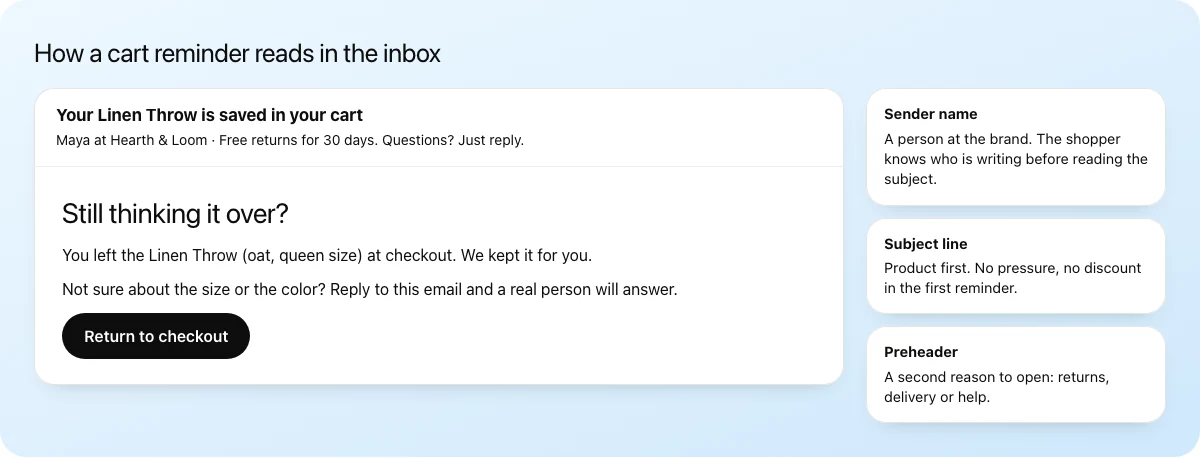
One Shopify detail before you write. Shopify counts a checkout as abandoned when it stays incomplete for more than ten minutes after the shopper entered an email address, according to the Shopify Help Center. So most "abandoned cart" emails on Shopify are really abandoned checkout emails, sent to people who got as far as typing their address. That is real intent. Write as if you are holding their order, not chasing a stranger.
One reminder, one job: map subject lines to your sequence
Most stores send two or three reminders. The common mistake is writing three versions of "You forgot something". Each email should earn its open for a different reason, so each subject line gets a different job.
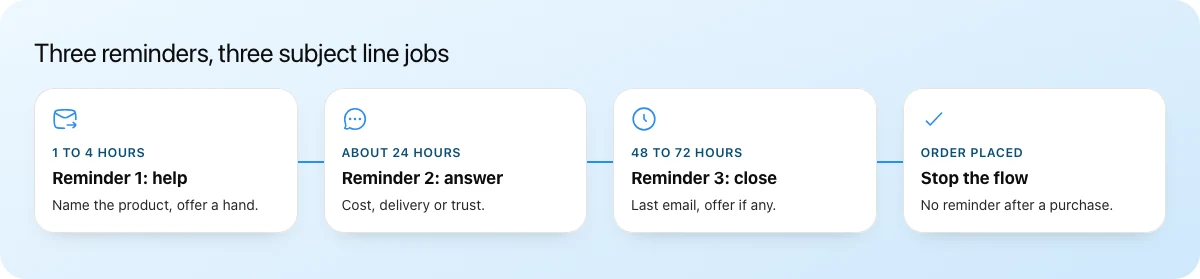
Reminder 1 helps. It goes out within a few hours (Klaviyo's sample sequence sends it after 2 to 4). The shopper may have been interrupted or hit a problem at checkout. A service tone works: name the product, offer help, no discount.
Reminder 2 answers. About a day later, write to the reason they left. Baymard Institute's survey ranks those reasons, and once you set aside people who were just browsing, the top three are clear:
Cost, delivery, trust: your second subject line should answer one of the three, whichever your store hears about most in support emails.
Reminder 3 closes. Two or three days after abandonment, say it is the last email. If you offer a discount at all, this is the place. For timing, email bodies and when to stop, our abandoned cart email guide covers the whole sequence.
20 abandoned cart email subject lines to copy
Filter by reminder, copy a line and replace the curly braces with your own details. Keep a claim (free shipping, a delivery day, a rating, a stock level) only if it is true for that shopper's cart.
- Reminder 1
Your {product} is saved in your cart
- Reminder 1
Did something go wrong at checkout?
- Reminder 1
Still deciding on the {product}?
- Reminder 1
Your {brand} cart, right where you left it
- Reminder 1
Any questions about the {product}? Just reply
- Reminder 1
You left the {product} behind
- Reminder 1
Picking up where you left off?
- Reminder 2
Your cart ships free
- Reminder 2
Order today, your {product} ships {ship_day}
- Reminder 2
Not sure? Returns are free for {days} days
- Reminder 2
{rating} stars from {count} reviews: the {product}
- Reminder 2
How the {product} fits, from people who bought it
- Reminder 2
Your {points} points can go toward this cart
- Reminder 2
Secure checkout, and real people if you need us
- Reminder 3
Last reminder about your cart
- Reminder 3
Should we keep your cart?
- Reminder 3
{discount} off your cart, until {day}
- Reminder 3
Free shipping on your cart ends {day}
- Reminder 3
Only {stock} left in your size
- Reminder 3
We'll stop reminding you after this one
Every placeholder needs a fallback. If the product name is missing, "Your cart is saved" beats a subject line with a hole in it.
Five common subject lines, rewritten
Most big lists recycle the same few lines. Here is what is wrong with them and a version that does the same job better:
| Common line | The problem | Rewrite |
|---|---|---|
| You forgot something! | Vague, and it blames the shopper | Your {product} is saved in your cart |
| Complete your purchase now | An order, not a reason | Questions about the {product}? Just reply |
| Hurry, your cart is expiring! | Usually untrue: the cart does not expire | Should we keep your cart? |
| 10% off if you buy today | Discount in reminder 1 trains shoppers to wait | Your cart ships free (if it does) |
| Hey {first_name}, still there? | Breaks when the name is empty, says nothing about the cart | Still deciding on the {product}? |
For full email bodies to go with these lines, see our roundup of abandoned cart email templates.
Subject line and preheader pairs that work together
The preheader is the second line in the inbox. Leave it empty and many email clients fill it with the first text they find, often "View in browser" or an image description. Use it for the reason the subject line has no room for.
| Reminder | Subject line | Preheader | Why it works |
|---|---|---|---|
| 1 | Your {product} is saved in your cart | Questions about size or delivery? Just reply. | Names the product and offers help, with no pressure |
| 1 | Did something go wrong at checkout? | If the payment did not go through, your cart is saved. | Service tone, useful when checkout errors happen |
| 1 | Your {brand} cart, right where you left it | One tap and you are back at checkout. | Plain and branded, close to the best converter in Rejoiner's data |
| 2 | Your cart ships free | You are over the {threshold} free shipping line. | Answers the top reason people leave: extra costs |
| 2 | Order today, your {product} ships {ship_day} | Delivery in {x} business days. | Answers the second reason: slow delivery |
| 2 | {rating} stars from {count} reviews: the {product} | "{short quote from a real review}" | Answers doubt with proof, if the numbers are real |
| 3 | Should we keep your cart? | One click to finish, or ignore this and we'll stop. | Hands control back to the shopper |
| 3 | {discount} off your cart, until {day} | Use code {code} at checkout. | States the offer and a real end date |
| 3 | We'll stop reminding you after this one | Your {product} is still in your cart. | An honest last email, no invented deadline |
Highest performing abandoned cart subject lines: what the data shows
Lists of the "highest performing" email subject lines for abandoned cart recovery rarely show numbers. One that does is Rejoiner's analysis of 7,140,646 abandoned cart sends, published in January 2025. It ranks five lines its customers used:
| Subject line, as sent | Business | Sent after | Open rate | Conversion rate (per open) |
|---|---|---|---|---|
| Your [Brand Name] Basket | Garden and fencing retailer | 1 day | 52.14% | 32.73% |
| You Left Something In Your Basket – Can We Help? | Cosmetics | 1 hour | 54.34% | 15.95% |
| Tickets Are Still Available! | Live event tickets | 30 minutes | 46.58% | 13.95% |
| Oops, Did Something Go Wrong? | Leather accessories retailer | 20 minutes | 66.28% | 13.26% |
| Your Rental Quote. | Car rental quotes | 30 minutes | 65.34% | 12.76% |
Rejoiner's worked example counts sales among opened emails, so these conversion rates are per open, not per send. Three lessons stand out:
- Opens and orders disagree. The two lines with the highest open rates had the lowest conversion rates of the five. A curious subject wins the open; the email then has to deliver.
- Plain and branded converted best. "Your [Brand Name] Basket" opened less than three of the others but converted at more than twice the rate of each of the other four. The shopper knew exactly what they were opening.
- Service may beat selling. Rejoiner says customer-service lines get better open rates than sales lines, but the page shows no side-by-side test. Treat it as something to test, not a rule.
These are one vendor's customers, in a few industries, with no sample size per line. Use them as starting hypotheses. For a wider yardstick, Klaviyo publishes flow benchmarks from its own customer base, and it reports clicks and revenue, not opens:
Choosing cart abandonment email subject lines by situation
No single line wins for every store. Choose the style by what you sell and what you can prove. Here is how the five common styles compare:
| Style | Service | Product name | Review proof | Discount | Urgency |
|---|---|---|---|---|---|
| Example | Did something go wrong at checkout? | Your {product} is saved | {rating} stars from {count} reviews | {discount} off until {day} | Only {stock} left in your size |
| Best slot | Reminder 1 | Reminder 1 or 2 | Reminder 2 | Reminder 3 | Reminder 3 |
| Protects your margin | ✓ | ✓ | ✓ | ✗ | ✓ |
| Works without extra data | ✓ | ✗ | ✗ | ✓ | ✗ |
| Answers a reason to leave | ✓ | ✗ | ✓ | ✓ | ✗ |
| Main risk | Reads generic | Empty product variable | Claim not true for this product | Shoppers learn to wait | Fake scarcity |
Then adjust for your store:
- High-ticket products (furniture, electronics): lead with service and proof. Someone weighing a large purchase wants answers, not a countdown.
- Low-price, impulse products: the product name alone often does the job. Keep the line short.
- A free shipping threshold: if the cart is just under it, say so in reminder 2, for example "Add {amount} for free shipping".
- Apparel: sizing is the usual doubt. A "how it fits" line backed by reviews answers it better than a coupon.
- Loyalty members: mention points they can spend. With a loyalty and rewards program in the same app, the email can show each customer's points balance.
- Stores that always discount: at least keep the code out of reminder 1, and consider offering it only on high-value carts.
Review proof only works if you have the reviews. A line like "4.8 stars from 312 reviews" (an example, not real data) must match what the product page shows. If you collect reviews with Trio's reviews module, the email body can quote one of them, which backs up the subject line instead of asking the shopper to take your word for it.
Move the slider to compare a generic reminder with a specific one for the same cart:
You left the Linen Throw (oat, queen size) in your cart. We kept it for you.
Free returns for 30 days. Questions about the size? Reply to this email.
Return to checkoutYour cart is waiting. Complete your purchase now before it's too late!
Buy nowEmojis, names and honesty: abandoned cart email subject line rules
Abandoned cart email subject lines with emojis
An emoji can help a line stand out, but it can also make a reminder read like an ad, and it looks different from one device to another. Use one at most, put it after the words and never let it replace the product name. Four that stay readable:
- 🛒 Your {product} is still in your cart
- Your {product} is waiting 👀
- Your cart ships free 📦
- Last call on your cart ⏳
Test the emoji version against the plain one before you keep it. The same goes for playful lines such as "Your cart is feeling a little lonely": they suit snacks, pet products or gifts, and feel off for skincare or high-ticket items. Match the voice your customers already know from your store.
First names and other personalization
Klaviyo's benchmark article suggests adding the recipient's first name to the subject line and details of the products left behind to the message. In the subject line itself, the product is usually the stronger signal, because it is specific to this email and no other. Whatever you insert, set a fallback: "Hi ," in a subject line tells the shopper a machine sent it.
What the FTC says about subject lines
In the US, the FTC's CAN-SPAM compliance guide states that "the subject line must accurately reflect the content of the message." Its transactional category covers messages about a transaction the recipient "already has agreed to", and a cart the shopper did not buy is not that. The cautious course is to treat cart reminders as marketing: an honest subject, an unsubscribe link and your postal address. Lines to avoid:
- "Re:" or "Fwd:" when there was no conversation.
- "Your order confirmation" or "Payment failed" when nothing was ordered or charged.
- Stock or deadline claims that are not true. "Only 2 left" has to come from real inventory.
- A discount in the subject that the email does not actually give.
How to test abandoned cart subject lines in Shopify
Opens are a weak signal. Apple Mail Privacy Protection can load emails on the shopper's behalf and register opens no person made, and the Rejoiner table above shows opens and orders moving apart. Judge each abandoned cart email subject line on what happens after the open:
- Change one thing. Subject line only, with the same timing, body and offer.
- Pick the metric first: click rate, then orders or attributed revenue per email sent.
- Run long enough. A flow sends one email at a time, so wait for a few hundred sends per version as a rough floor, and never compare a sale week with a normal one.
- Start with reminder 1. It reaches the most shoppers, so a better line there moves the most orders.
- Keep a log of each version, its dates and its result, so you do not retest the same idea next year.
For campaigns, an A/B test splits the list for you. In Trio, A/B tests (Growth and up) send two subject lines to a test share of the audience, 20% by default, pick the winner on opens or clicks after a wait, then send it to the rest. A flow is easier to test in periods, as above. If you also resend campaigns, the same rule applies to resending to non-openers: change the subject, not the offer.
On Shopify you can run the reminders with Shopify's own abandoned checkout automation or with an email app; our guide to Shopify email automation walks through the setup. In Trio's email marketing module, the abandoned checkout automation runs on Starter and up (from $29 a month, see pricing). It sends up to three reminders on the schedule you set, with an optional coupon. Trio checks for abandoned checkouts every 30 minutes and holds sends during quiet hours at night, so plan the first reminder in hours, not minutes.
Trio credits an order to an automation when the shopper clicked one of its emails in the 5 days before ordering, so you can compare two periods on attributed revenue instead of opens. If you would rather not write the sequence yourself, Mailo, Trio's email agent, can draft it from one sentence, and nothing goes out until you approve it.
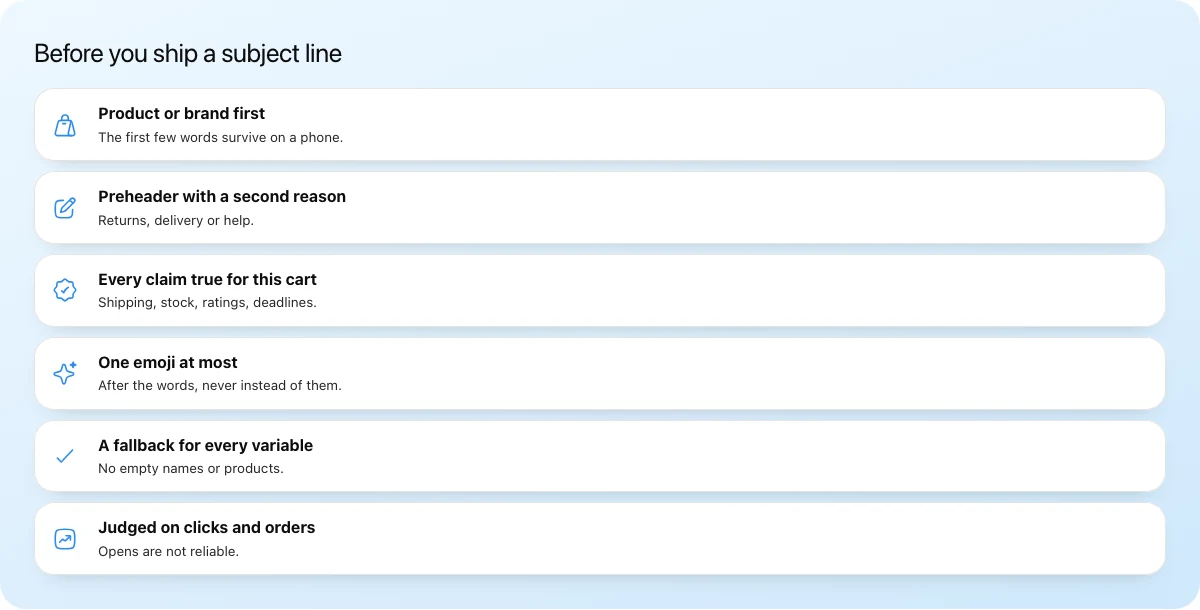
Start with three lines, one per reminder, and change one at a time. When the shopper finally buys, the next subject line they see is in your post-purchase email, and that one has a different job again: making them glad they came back.
Frequently asked questions
- What is a good subject line for an abandoned cart email?
- One that names the product and sounds like a person, such as "Your Linen Throw is saved in your cart". Keep discounts and deadlines for the last reminder. In Rejoiner's analysis of more than 7 million abandoned cart sends, a plain branded line, "Your [Brand Name] Basket", had the highest conversion rate of the five lines it ranked.
- How long should an abandoned cart email subject line be?
- Short enough that the important words survive on a phone screen. Put the product or the brand in the first three or four words and treat the rest as a bonus. If you need a second idea, put it in the preheader instead of making the subject longer.
- Should the first abandoned cart email include a discount?
- Usually not. The first reminder reaches many shoppers who were simply interrupted, and a discount there gives away margin on orders you might have won anyway. If you offer one, put it in the last reminder and consider keeping it for high-value carts, as Klaviyo's 2026 benchmark article suggests.
- Do emojis work in abandoned cart email subject lines?
- They can, but test them on your own list. Use one at most, place it after the words and never let it replace the product name. Emojis look different from one device to another and can make a reminder read like a promotion.
- What is a good open rate for abandoned cart emails?
- Open rates are unreliable, because privacy features such as Apple Mail Privacy Protection can register opens that no person made. Track click rate and orders instead. Klaviyo reports an average click rate of 6.0% for abandoned cart emails in its October 2026 benchmark, and 11.3% for the top 10% of brands.
- Should I put the customer's first name in the subject line?
- It can help, but the product name is usually more specific to the email. If you use the first name, set a fallback so an empty field never shows. A missing or wrong name makes the email look automated, which is the opposite of what a reminder needs.
- Can I write "Re:" or "Your order" in an abandoned cart subject line?
- No. The FTC's CAN-SPAM guide says the subject line must accurately reflect the content of the message. "Re:" suggests an existing conversation and "Your order" suggests a purchase that never happened, so both mislead the shopper.
- What is the difference between abandoned cart and abandoned checkout emails on Shopify?
- You can only email a shopper whose address you have, and on Shopify that usually means someone who started checkout. Shopify counts a checkout as abandoned when it stays incomplete for more than ten minutes after the email address was entered. So most "abandoned cart" emails on Shopify are abandoned checkout emails.
- How many abandoned cart emails should I send?
- Two or three, then stop. A common pattern is a first reminder within a few hours, a second one about a day later and a last one two or three days after the checkout was abandoned. Give each email its own subject line and its own reason to open.
- Can Trio send abandoned cart emails?
- Yes, on Starter and up. Trio's abandoned checkout automation sends up to three reminders on a schedule you set, with an optional coupon. It credits an order to the automation when the shopper clicked one of its emails in the 5 days before buying, so you can compare subject lines on revenue rather than opens.
Related articles
Write an abandoned cart email that recovers orders: timing, a 3-email sequence to copy, discount break-even math, compliance and Shopify setup. Start …
November 25, 2026Email marketingBest abandoned cart emails: 15 free templates to copy, and when to send eachThe best abandoned cart emails as 15 free templates: subject, preview, body and button for each reason shoppers leave, plus send timing. Copy them now…
November 25, 2026Email marketingEcommerce email marketing: the complete 2026 guide for Shopify storesEcommerce email marketing step by step: which flows to build first, starting schedules, copyable emails, deliverability rules and costs. Start free wi…
November 25, 2026