


Best email marketing software in 2026: 6 tools for online stores, priced by how you send

- Decide first between general newsletter software and ecommerce email software. A store needs the second kind, because its flows trigger on orders and checkouts.
- The pricing model moves your bill more than the entry price. At 5,000 contacts, per-email tools cost $0 to $50 a month from 2 to 12 emails per contact; Klaviyo's Email plan stays at $100 until it hits its send cap.
- Shortlist two tools with the decision table, then run the 7-day trial script on both before you pay.
The best email marketing software for an online store is the one that reads your store data, runs your core flows on a plan you can afford, and keeps its price predictable as your list grows and your sending habits change. Most "best of" lists rank newsletter tools on editors and template counts, and give each price at a different list size, so no two tools can be compared. This guide compares six tools that stores use, with prices read from each vendor's official page or Shopify App Store listing on November 25, 2026, and works out what each one costs as you send more often.
Disclosure: Trio is our product. It is in this list, we put it last, and we say plainly where other tools beat it. If you are new to the channel itself, start with our guide to ecommerce email marketing, then come back to pick a tool.
The best email marketing software at a glance
- Klaviyo: best for data-heavy brands that want email, SMS and predictive analytics in one platform.
- Omnisend: best for email plus SMS and pop-ups, with 24/7 live support on every plan.
- Mailchimp: best for stores that also need landing pages, social posting and surveys.
- Shopify Messaging: best low-cost start, managed from the Shopify admin.
- Judge.me Email Marketing: best pay-per-email pricing, with your Judge.me reviews inside emails.
- Trio (our product): best for stores that want reviews, email and loyalty in one app and one bill.
| Feature | Klaviyo | Omnisend | Mailchimp | Shopify Messaging | Judge.me Email | Trio |
|---|---|---|---|---|---|---|
| Free plan | 250 profiles, 500 emails/mo | 250 contacts, 500 emails/mo | 250 contacts, 500 sends/mo | First 10,000 emails/mo | 15,000 emails/mo | 250 contacts, 500 emails/mo |
| Paid plans start at | $20/mo (500 profiles) | $16/mo (500 contacts) | $13/mo | $1 per 1,000 emails | $0.15 per 1,000 emails | $29/mo (1,000 contacts) |
| Price grows with | Active profiles | Contacts | Contacts | Emails sent | Emails sent | Contacts (plan caps) |
| Automations on the free plan | Not specified | Abandoned cart, welcome | ✗ | yes (count toward the 10,000) | 8 ready-made | ✗ |
| SMS | Add-on | Pro plan | Add-on | Per message | Not listed | ✗ |
| Pop-ups or sign-up forms | ✓ | ✓ | ✓ | Via Shopify Forms | ✓ | Inline section only |
| Product reviews built in | 50 orders/mo below Marketing plan | ✗ | ✗ | ✗ | Separate Judge.me app | ✓ |
| Loyalty program built in | ✗ | ✗ | ✗ | ✗ | ✗ | ✓ |
Prices are in USD and exclude launch promotions. Sources: each vendor's pricing page and Shopify App Store listing, checked November 25, 2026.
General vs ecommerce email marketing software: which kind you need
The top-ranking lists for this search lead with general marketing platforms such as Constant Contact, HubSpot and Brevo, picked for every kind of sender. A store has a narrower job: its most profitable emails are triggered by what a customer does in the shop, not by a calendar. That is why this guide only covers tools that sync with a store.
| General email software | Ecommerce email software | |
|---|---|---|
| Built around | Contacts, forms and tags | Orders, products, checkouts and customers |
| Flows trigger on | A signup, a date, a tag, a link click | An abandoned checkout, an order, days since the last order |
| What the email can show | Text, images and links you paste | Live product blocks, personal codes, order and loyalty data |
| What reports show | Opens, clicks and list growth | Revenue credited to each email and flow |
| Good fit | Newsletters, B2B, events, creators | Online stores, from first sale to large catalogs |
A quick test tells you which family a tool belongs to: open its automation builder and look for an "abandoned checkout" or "order placed" trigger. If you have to wire one up with a third-party connector, it is general software. Mailchimp sits between the two: a general platform with a Shopify integration that syncs segments and customer events.
How we compared these email marketing tools
We did not score "ease of use", which depends on who is clicking. We compared five things that change outcomes for a store:
- Store data sync: do orders, products and customers flow in on their own, so flows can trigger on real events?
- Flows on your plan: are welcome, abandoned checkout, post-purchase and win-back included at the price you will pay, or only on a higher tier?
- The pricing model: what makes the bill grow, list size or emails sent?
- Sending control: can you send from your own domain and authenticate it?
- What else it replaces: SMS, pop-ups, reviews or loyalty that you would otherwise buy separately.
We did not run inbox placement tests, so we make no deliverability ranking. Inbox placement depends heavily on your own domain authentication, list quality and complaint rate, which is exactly what mailbox providers check. One older favorite is missing on purpose: Privy's Shopify App Store listing read "not currently available on the Shopify App Store" when we checked, so Shopify stores cannot install it from there.
The 6 best email marketing platforms for online stores
1. Klaviyo: best for data-heavy brands
Klaviyo has the widest channel list of the six: email, SMS, WhatsApp, mobile push and sign-up forms in one platform. On top of that it offers predictive analytics, send-time optimization, product recommendations, AI segments and Composer, an agentic builder that drafts campaigns and flows.
The free plan covers 250 active profiles and 500 emails a month. The Email plan starts at $20 for 500 active profiles, then $30 at 1,000, $100 at 5,000, $150 at 10,000 and $400 at 25,000, with monthly sends capped at 10 times your profile count. The Marketing plan ($130 at 5,000 profiles) adds social marketing, Customer Hub and reviews with no order limit. SMS is a paid add-on. Our Klaviyo pricing breakdown walks through every tier.
Watch out for:
- The bill follows your active profiles, so people who never open still cost money until you clean them out.
- No native loyalty program; Klaviyo relies on partner apps for that.
- The App Store listing notes that some charges may be billed by Klaviyo outside your Shopify invoice.
2. Omnisend: best for email, SMS and pop-ups on a budget
Omnisend combines email, SMS and web push with pre-built ecommerce automations. It also includes pop-ups, spin-to-win and sign-up forms with Forms AI, an AI segment builder, a product recommender and personalized send times. Live support is available 24/7 on every plan, including Free.
The free plan covers 250 contacts and 500 emails a month, with abandoned cart and welcome automations. Standard has a list price of $16 a month for up to 500 contacts and 6,000 emails; Pro is $59 for up to 2,500 contacts, with unlimited emails under a fair-use cap of 60 times your list, and SMS from $0.007 per message at high US volume. When we checked, the site showed 30% off for the first three months, so budget on the list price. Billing is based on contacts who received messages. Details in our Omnisend pricing explainer.
Watch out: SMS is Pro-only, prices above those entry tiers were not published in a table we could read on the check date, and there are no native reviews or loyalty.
3. Mailchimp: best when email is one channel among many
Mailchimp is a general marketing platform: email, signup forms, landing pages, social posting, surveys and a Creative Assistant for design. For stores, it syncs Shopify segments and customer events and reports attributed revenue in Shopify.
The free plan allows 250 contacts and 500 sends a month (250 a day), with no automation flows. Essentials starts at $13 with flows of up to 4 steps; Standard starts at $20 with up to 200 steps, send-time optimization and behavioral targeting; Premium starts at $350. Abandoned cart, welcome and back-in-stock automations need a paid plan. Our Mailchimp Shopify integration guide covers the setup.
Watch out: overage charges apply above your contact or send limit, and you should check that your abandoned checkout sequence fits in 4 steps before you settle on Essentials.
4. Shopify Messaging: the cheapest way to start
Shopify's own tool, formerly Shopify Email, sends email, SMS and WhatsApp campaigns from the Shopify admin. It includes automations, segmentation and templates, AI help for subject lines, copy and send times, and Sidekick can edit a branded email from a prompt. It works natively with Shopify Flow, Shopify Forms and your admin data, and charges land on your Shopify bill.
Per Shopify's email pricing page, the first 10,000 emails each month are free, then $1 per 1,000 up to 300,000, with lower rates above that. Abandoned checkout emails are always free, automations count toward the 10,000, and unused emails do not roll over. SMS costs $0.012 per message in the US. Our Shopify email automation guide shows which flows to build first.
Watch out: there are no reviews or loyalty features, and Shopify's help center says Shopify Network Intelligence must be enabled to use it.
5. Judge.me Email Marketing: best pay-per-email pricing
Judge.me launched this separate email app on July 14, 2026, next to its reviews app. You pay per email sent, not by list size: the free plan includes 15,000 emails a month, then $0.15 per 1,000. It ships with 8 ready-made automations (welcome, abandoned cart and checkout, browse abandonment, win-back, back in stock and more), campaigns, segments, sign-up pop-ups, revenue attribution and your Judge.me reviews inside emails. The Awesome plan, at $15 a month plus usage, adds your own sending domain and removes Judge.me branding.
Watch out: it is new. Its App Store listing showed 105 reviews at our check date, against roughly 1,600 to 4,900 for the Klaviyo, Omnisend, Mailchimp and Shopify Messaging listings. It has no loyalty program.
6. Trio: best for reviews, email and loyalty in one app (our product)
Trio is our Shopify app. It brings product reviews, email marketing and a loyalty program together, and the three modules share the same customer data. On the email side, you get a drag-and-drop editor with product, review quote and coupon blocks, more than 40 ready-made templates, and each customer's points balance as a variable. Automations (Starter and up) cover welcome, post-purchase, abandoned checkout with up to 3 reminders, win-back after 30, 60 or 90 days, birthday, VIP tier change, points expiry, a thank-you after a review and the review request. A/B tests start on Growth, and Trio AI drafts a campaign from a short brief on paid plans.
The Free plan covers 250 contacts and 500 emails a month, with campaigns but no automations. Starter is $29 a month (1,000 contacts, 10,000 emails), Growth $79 (5,000 contacts, 50,000 emails) and Scale $199 (25,000 contacts, 250,000 emails), with a 14-day free trial on paid plans and two months free on annual billing. Reviews and loyalty rewards are in every plan. Full limits are on the Trio pricing page.
Where other tools beat Trio:
- Trio is email only: no SMS, WhatsApp or push.
- No pop-up builder, only an email-capture section you place in your theme.
- Segments use subscriber status, signup source and signup date, plus three loyalty presets. There are no segments by purchase history and no browse abandonment or predictive analytics.
- Sending from your own domain requires Scale.
- Limits are hard: a campaign that would exceed the monthly quota is refused, and contacts beyond the plan cap are not added. Trio warns you before you reach them.
- It works on Shopify only.

Email marketing software pricing: what your sending frequency does to the bill
Entry prices tell you little. What matters is what makes the bill grow, and there are three pricing models:
- Per contact or profile (Klaviyo, Omnisend, Mailchimp): the bill follows list size, whether you email weekly or daily, up to a send cap.
- Per email sent (Shopify Messaging, Judge.me Email Marketing): the bill follows volume, so a big list you email rarely stays cheap.
- Plans with caps (Trio): a fixed price for a contact cap and a monthly email quota.
Most comparisons price tools at one assumed frequency. Yet the frequency is the number you control, and it rises in peak season. So we held the list at 5,000 contacts and priced each tool from a light schedule (2 emails per contact a month) to a heavy one (12).
| Tool and plan | Pricing model | 2 per contact (10,000 emails) | 4 per contact (20,000) | 8 per contact (40,000) | 12 per contact (60,000) |
|---|---|---|---|---|---|
| Judge.me Email Marketing (Free) | Emails sent | $0 | $0.75 | $3.75 | $6.75 |
| Shopify Messaging | Emails sent | $0 | $10 | $30 | $50 |
| Trio Growth, then Scale | Contact cap and email quota | $79 | $79 | $79 | $199 (above Growth's 50,000 emails) |
| Klaviyo Email | Active profiles | $100 | $100 | $100 | Above the 50,000 send cap |
| Omnisend (Standard, Pro) | Contacts | Not published | Not published | Not published | Not published |
| Mailchimp (Essentials, Standard) | Contacts | Not shown | Not shown | Not shown | Not shown |
How we computed it: Shopify Messaging bills emails above 10,000 at $1 per 1,000; Judge.me bills emails above 15,000 at $0.15 per 1,000; Klaviyo and Trio use the published tier for 5,000 contacts. Omnisend's Pro plan covers up to 2,500 contacts and Mailchimp's USD tier table did not display for our locale, so we left those cells empty rather than guess.
What the table shows:
- Sending frequency changes the per-email bills, but they stay small: Shopify Messaging would only reach Klaviyo's $100 at 110,000 emails a month, more than Klaviyo's own send cap allows.
- Per-contact plans are flat until a cap. At 5,000 contacts and past 10 emails per contact, Klaviyo's Email plan and Trio's Growth plan both run out of sends, and the next step on Trio is Scale at $199.
- Shopify Messaging can come in lower than shown, because abandoned checkout emails are free. Judge.me's Awesome plan adds $15 a month for your own domain.
- At other list sizes the gap holds. At 1,000 contacts and 4,000 emails, Shopify Messaging and Judge.me cost $0, Trio Starter $29 and Klaviyo $30. At 25,000 contacts and 100,000 emails: Judge.me $12.75, Shopify Messaging $90, Trio Scale $199, Klaviyo $400. Our Shopify email marketing comparison adds a 10,000-contact tier and prices the full reviews and loyalty stack.
If you compare email alone, the pay-per-email tools win at every frequency, and that includes beating Trio. Klaviyo costs the most in exchange for the deepest channel and analytics features. Trio sits in between and makes sense when you would otherwise pay separately for reviews and loyalty.
Free email marketing software: what the free plans really cover
The free plans split in two. Klaviyo, Omnisend, Mailchimp and Trio stop at 250 contacts and 500 emails a month, which is a trial-sized list. Shopify Messaging (10,000 emails) and Judge.me Email Marketing (15,000 emails) count emails, not contacts, so a small store with a growing list can run on them for months. Before you settle, check the automations: Mailchimp's and Trio's free plans send campaigns only.
Which email marketing tool fits your store: a decision table
Start from your situation, not from a ranking. Shortlist two tools, then run the 7-day trial below on both.
| If you... | Pricing model to favor | Shortlist | Why |
|---|---|---|---|
| Are a small business starting out, mostly campaigns | Per email | Shopify Messaging, Judge.me Email Marketing | Their free tiers cover 10,000 and 15,000 emails a month |
| Have a big list you email a few times a month | Per email | Judge.me Email Marketing, Shopify Messaging | Quiet contacts cost nothing |
| Want SMS and email in one place | Per contact or per message | Klaviyo, Omnisend, Shopify Messaging | SMS is built in or sold as an add-on |
| Need pop-ups to grow your list | Either | Omnisend, Klaviyo, Judge.me Email Marketing | Pop-ups or sign-up forms are included |
| Run predictive or complex segmentation | Per profile | Klaviyo | Predictive analytics and AI segments |
| Also run landing pages, surveys and social posts | Per contact | Mailchimp | A general marketing platform beyond store email |
| Already collect reviews with Judge.me | Per email | Judge.me Email Marketing | Your Judge.me reviews show inside emails |
| Pay for reviews and loyalty separately | Plan with caps | Trio | Reviews, email and loyalty share one customer record |
| Have more than 25,000 contacts and email often | Model both | Shopify Messaging, Judge.me Email Marketing, Klaviyo | Trio's Plus plan above 25,000 contacts is on quote |
Features that matter in the best email marketing tools for ecommerce
A store's email program rests on a handful of automated flows. Whatever tool you pick, check that these five run on the plan you will actually pay for.
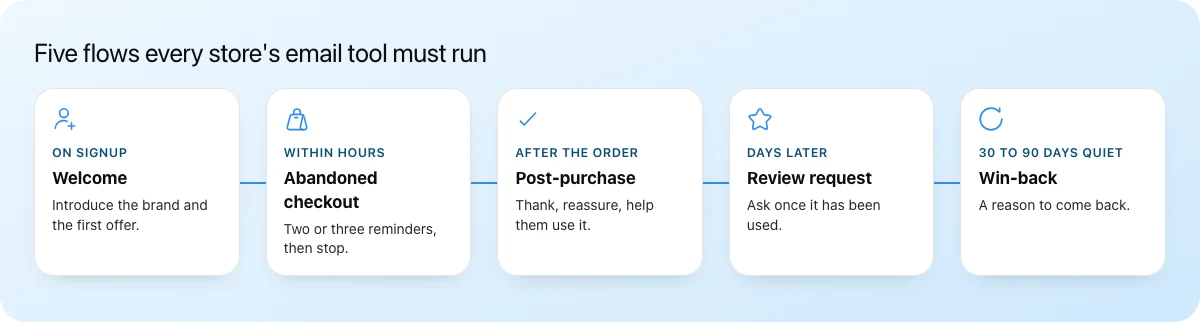
Must-haves, in order of impact:
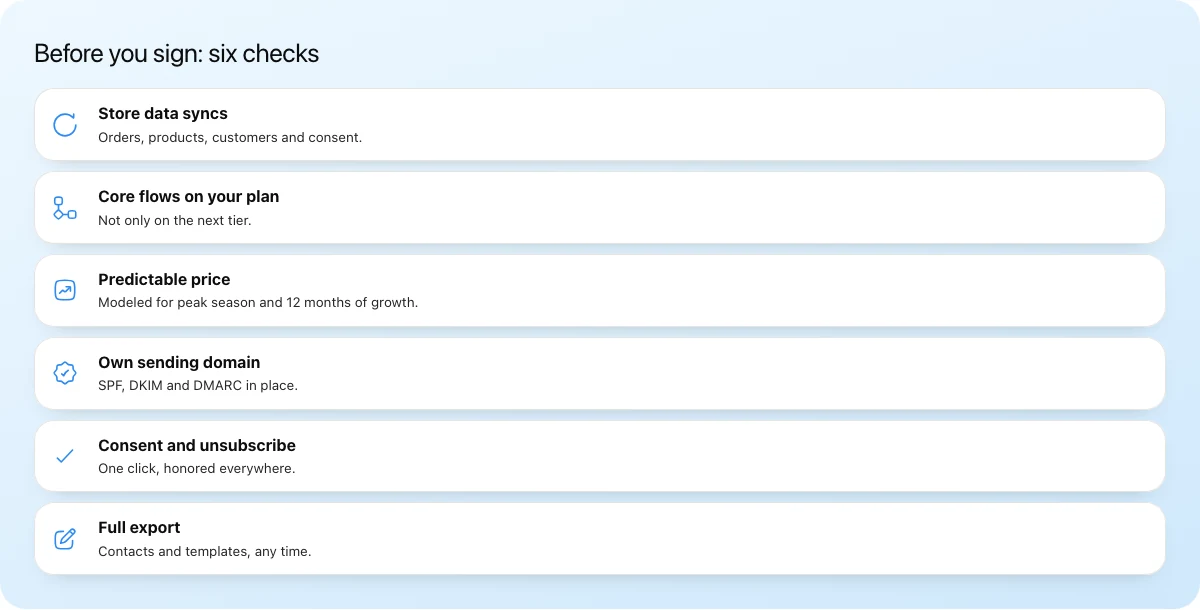
- Store data sync for orders, products and customers, including each customer's marketing consent.
- An abandoned checkout flow with more than one reminder that stops when the customer buys. Our abandoned cart email guide covers timing and copy.
- Post-purchase and review request flows. See our post-purchase email playbook for the sequence.
- Your own sending domain, authenticated with SPF, DKIM and DMARC. Google's email sender guidelines require all three for anyone sending 5,000 or more messages a day to Gmail accounts, plus one-click unsubscribe for marketing email. Google asks every sender to keep the spam rate below 0.3%, and recommends staying under 0.1%.
- A visible unsubscribe link and your postal address. The FTC's CAN-SPAM guide requires a valid physical postal address and opt-outs honored within 10 business days, with penalties of up to $53,088 per violating email.
- A full contact export at any time, so you can leave.
Nice to have, and fine to add later: predictive analytics, AI writing, SMS, multivariate testing and spin-to-win forms. They help once the five flows run well; they rarely fix a program where those flows are missing.
The biggest difference between generic newsletter software and ecommerce email software is what the email can say about the customer. Slide to compare.
Thanks again for your order on October 20.
You now have 120 points, enough for $5 off your next order.
Running low on the 30-day pack? Reorder in one click.
Use my $5Here is what is new at the shop this month.
Read our latest blog post.
Visit the shopHow to trial an email marketing platform in 7 days
Free trials are short, so use a script. Run the same seven checks on each tool you shortlisted and write the answers down.
- Day 1, sync: connect your store and spot-check five recent customers. Are their orders, products and consent status correct?
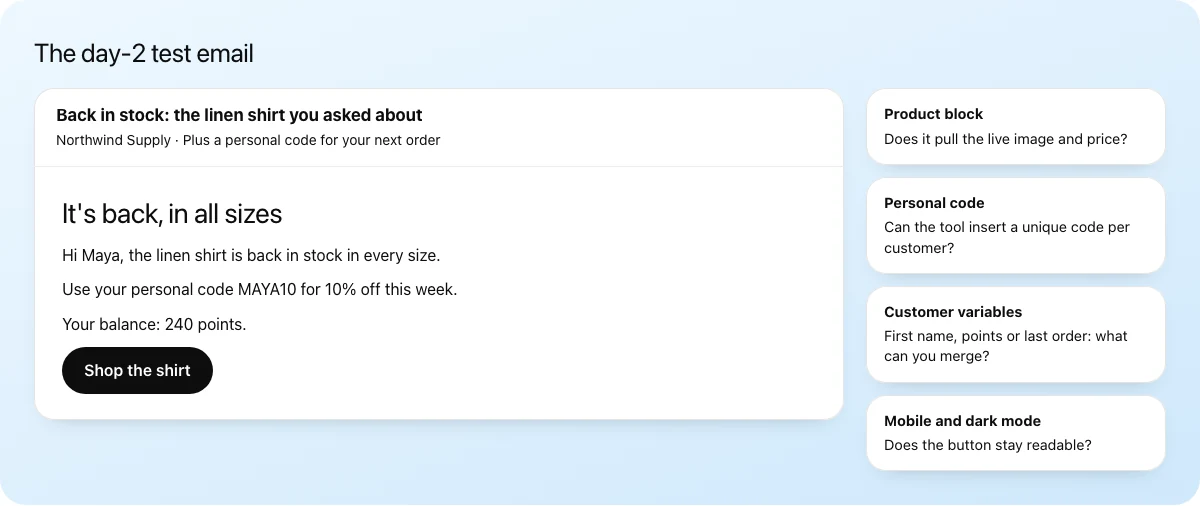
- Day 2, editor: rebuild your best-performing email with the test below. Send it to Gmail, Outlook and Apple Mail, and open it on a phone in dark mode.
- Day 3, abandoned checkout: build the flow with two reminders, start a real checkout with your own email address and leave. After the first reminder, buy, and confirm the second one never arrives.
- Day 4, domain: authenticate your sending domain and open the headers of a test email to confirm the List-Unsubscribe line is there.
- Day 5, consent: import a CSV of 50 contacts that includes a few unsubscribed people, and confirm they stay unsubscribed.
- Day 6, price: model your next 12 months of list growth and your peak-season sending frequency against the tool's pricing model, not just this month.
- Day 7, exit: export everything, contacts and templates, to confirm you can leave without friction.
If Trio is on your shortlist, this is what the trial looks like in the app.
Switching email marketing software without losing subscribers
A migration usually goes wrong in one of three ways: unsubscribes get lost, people receive the same email twice, or a cold list is mailed from a new domain. Moving from a general newsletter tool adds a fourth: its tags and lists rarely map to store segments, so plan to rebuild segments from your store data rather than import them. Then work in this order:
- Export contacts with their consent status, plus your unsubscribe and suppression lists. Import the suppressions first.
- Import only people who agreed to receive marketing email. Mailing contacts without consent from a fresh domain is a fast way to collect spam complaints.
- Rebuild flows by revenue impact: abandoned checkout, welcome, post-purchase, then the rest.
- Switch flows one at a time, and turn each off in the old tool the same hour you turn it on in the new one, so nobody gets two emails.
- Send your first campaigns from the new tool to subscribers who clicked recently, then widen the audience.
- Keep the old account until its last scheduled emails have gone out, and export your reports before you close it.
Judge the new tool on clicks and attributed revenue, not opens: Apple Mail Privacy Protection can record opens nobody made, so open rates often jump after a switch for reasons unrelated to the tool.
The tool matters less than the flows you run and the list you keep clean. Pick the software whose pricing model fits how often you send, check the five core flows on your plan, and give the winner a full quarter before judging it. Then build those flows one at a time, starting with abandoned checkout.
Frequently asked questions
- What is the best email marketing software for a small online store?
- Start with a tool whose free tier covers your volume and that syncs your store data. Shopify Messaging (10,000 free emails a month) and Judge.me Email Marketing (15,000 free emails a month) were the cheapest starts we found. Move to Klaviyo or Omnisend when you need SMS or advanced segmentation, or to Trio if you also want reviews and loyalty in the same app.
- Is there completely free email marketing software?
- Yes, with limits. Klaviyo, Omnisend, Mailchimp and Trio have free plans capped at 250 contacts and 500 emails a month. Shopify Messaging gives 10,000 free emails a month and Judge.me Email Marketing 15,000. Check which automations each free plan includes, because Mailchimp's and Trio's free plans have no automation flows.
- How much does email marketing software cost per month?
- It depends on the pricing model, your list size and how often you send. For 5,000 contacts receiving four emails a month, published prices on November 25, 2026 were $0.75 on Judge.me Email Marketing, $10 on Shopify Messaging, $79 on Trio Growth (reviews and loyalty included) and $100 on Klaviyo's Email plan.
- What is the difference between general and ecommerce email marketing software?
- General email software is built around contacts, forms and tags, which suits newsletters, B2B and creators. Ecommerce email software reads your orders, products and checkouts, so it can send abandoned checkout reminders, show live products and report the revenue each email brought in. An online store needs the second kind.
- Is Klaviyo better than Mailchimp for ecommerce?
- Klaviyo is built around store data, with predictive analytics, product recommendations, AI segments and SMS, WhatsApp and push in one platform. Mailchimp is broader (landing pages, social posting, surveys) and starts at $13 a month, but its free plan has no automation flows and Essentials limits flows to 4 steps. For a store that lives on automated flows, Klaviyo is usually the stronger fit.
- Should email and SMS be in the same tool?
- It helps if SMS is a real channel for you, because one tool shares consent, timing and reporting. Klaviyo (add-on), Omnisend (Pro plan), Mailchimp (add-on) and Shopify Messaging offer both. If you do not plan to send SMS in the next year, do not pay for it. Trio, for example, is email-only.
- Does Shopify have built-in email marketing?
- Yes. Shopify Messaging, formerly Shopify Email, sends email, SMS and WhatsApp campaigns from the Shopify admin. According to Shopify's help center, the first 10,000 emails each month are free, then $1 per 1,000, and abandoned checkout emails are always free.
- What features does email marketing software need for ecommerce?
- Automatic sync of orders, products and customers; abandoned checkout, welcome, post-purchase and win-back flows on your plan; product and coupon blocks; sending from your own domain with SPF, DKIM and DMARC; one-click unsubscribe; and a full contact export.
- Can Trio replace Klaviyo?
- For some stores. Trio covers campaigns, the core automations, A/B tests on Growth and attributed revenue, and adds reviews and loyalty. It has no SMS, no pop-up builder, no predictive analytics and no segments by purchase history. If you rely on those, stay on Klaviyo. If you mostly send campaigns and core flows and pay separately for reviews and loyalty, Trio can replace several tools.
- Is per-contact or per-email pricing cheaper?
- With the prices we checked on November 25, 2026, the per-email tools (Shopify Messaging, Judge.me Email Marketing) were cheaper than the per-contact plans at every sending frequency those plans allow. What per-contact plans buy is features, such as SMS, pop-ups, predictive analytics, or reviews and loyalty bundled in. So compare the price gap with the features you will actually use.
Related articles
Six Shopify email platforms compared on real monthly cost at 1,000 to 25,000 contacts, plus a decision table and a switching checklist. Find your fit …
November 25, 2026CompareBest Free Product Review App for Shopify: Top Picks 2026We compared the free plans of 7 Shopify review apps: order caps, photo reviews, Google stars and the real cost once you grow. Find the right one for y…
November 25, 2026CompareBest Loyalty Program Software (2026): 7 Tools and the Plan You Will Actually NeedCompare the best loyalty program software: Smile.io, LoyaltyLion, Yotpo, Joy, Rivo, Growave and Trio, with real costs at your order volume. Pick yours…
November 25, 2026