


Best Marketing Automation Tools for Ecommerce: 6 Shopify Picks for 2026

- Shopify Messaging plus Shopify Flow is the simplest low-cost start for most Shopify stores, and Judge.me Email is the cheapest at large list sizes. Klaviyo and Omnisend earn their price when you need SMS, pop-ups and deeper segmentation.
- Price every tool at your list size, not at its entry price. For 10,000 contacts receiving six emails a month, the tools with public per-size prices range from about $7 to $199 a month.
- Count the whole stack. Email, reviews and loyalty are three bills for most stores. An all-in-one app like Trio (our product) pays off when you need VIP tiers and shared customer data and can live without SMS.
Most lists of the best marketing automation tools for ecommerce mix CRMs, SEO suites and chat apps, quote an entry price and stop there. That is not how a Shopify store buys software. You pay at your list size, you run a handful of flows, and email is rarely the only app on the bill: reviews and loyalty usually add two more.
This guide compares six tools that Shopify stores use for email automation. We price each one at 1,000, 5,000 and 10,000 contacts, then add up the monthly cost of a full retention stack. Trio is our product and it is one of the six. We list its weak spots next to everyone else's, and every competitor figure comes from the vendor's pricing page or Shopify App Store listing, checked on November 25, 2026. If you want the strategy first (which flows, in which order), start with our ecommerce marketing automation guide.
Those are starting points, not your bill. The pricing section below does the math at three list sizes.
Best marketing automation tools for ecommerce: the short answer
- Best free start on Shopify: Shopify Messaging with Shopify Flow. 10,000 emails a month free, billed on your Shopify invoice.
- Best for depth and many channels: Klaviyo. Email, SMS, WhatsApp, push, forms and predictive analytics in one platform.
- Best for pop-ups and SMS on a budget: Omnisend. Pop-ups and spin-to-win forms are built in, SMS comes with Pro.
- Best price for big lists: Judge.me Email Marketing. Billed per email sent, not per contact.
- Best if your team already uses Mailchimp: Mailchimp. A familiar editor and Shopify segment sync, but no flows on the free plan.
- Best all-in-one for reviews, email and loyalty: Trio (ours). One app and one customer record, but no SMS.
The rest of this page explains each pick, shows the trade-offs and gives you a test to run before you commit.
How we picked and priced these marketing automation platforms
A tool made this list only if it met four conditions:
- It is a Shopify App Store app or a native Shopify feature, so orders, customers and consent sync without custom work.
- It runs ecommerce flows out of the box: at least a welcome series and an abandoned cart or checkout reminder.
- Its pricing is public on an official page we could read.
- You can still install it. Privy appears on many older lists, but its listing shows "This app is not currently available on the Shopify App Store" as of November 25, 2026, so it is not here.
General-purpose CRMs and enterprise suites fill a lot of "best of" lists: HubSpot, ActiveCampaign, Brevo or Drip show up on most of the pages that rank for this search. They can work for ecommerce, but we did not verify their Shopify pricing and flows for this guide, so we leave them out rather than quote numbers we cannot source. This guide sticks to tools a small Shopify team can install and run in an afternoon.
For costs we assume six emails per contact per month: four campaigns plus about two automated emails. Change the multiplier for your own store. The order between tools rarely moves; the gaps between them do.
Shopify email automation apps compared: the feature table
Here is what each tool includes, read from its pricing page and App Store listing. Trio is highlighted because it is ours, not because it wins every row. It does not.
| What you get | Shopify Messaging + Flow | Klaviyo | Omnisend | Mailchimp | Judge.me Email | Trio (ours) |
|---|---|---|---|---|---|---|
| Pricing basis | Emails sent | Active profiles | Contacts who received messages | Contacts | Emails sent | Contacts, by plan |
| Free tier | 10,000 emails a month | 250 profiles, 500 emails | 250 contacts, 500 emails | 250 contacts, 500 sends | 15,000 emails a month | 250 contacts, 500 emails |
| Automated flows | ✓ | ✓ | yes, welcome and cart on Free | from Essentials, 4 steps | yes, 8 ready-made | from Starter |
| SMS | yes, $0.012 per US message | paid add-on | on Pro | add-on | not listed | ✗ |
| Sign-up pop-ups | via Shopify Forms | ✓ | yes, incl. spin-to-win | signup forms | ✓ | no, inline section only |
| Product reviews | ✗ | yes, capped at 50 orders a month below Marketing | ✗ | ✗ | via the Judge.me reviews app | yes, built in |
| Loyalty program | ✗ | ✗ | ✗ | ✗ | ✗ | yes, built in |
| AI help | Sidekick edits emails from a prompt | Composer builds campaigns and flows | AI segments, product recommender | Creative Assistant | 50 AI generations on Free | Trio AI and six agents, with approval |
Two rows decide most choices. SMS and pop-ups push you toward Klaviyo, Omnisend or Shopify's own tools. Reviews and loyalty inside the same app point to Trio, or to a stack of separate apps that you connect yourself.
The 6 best marketing automation tools for ecommerce, reviewed
1. Shopify Messaging and Shopify Flow: the native baseline
Best for: stores sending under about 10,000 emails a month that want one bill.
Shopify Messaging, formerly Shopify Email, creates email and SMS marketing automations inside your Shopify admin. The first 10,000 emails each month are free on the Basic, Grow, Advanced and Plus plans. After that you pay $1 per 1,000 emails up to 300,000, according to the Shopify Help Center pricing page. Abandoned checkout emails are always free. Automations count toward the 10,000, and unused emails do not roll over.
Shopify Flow is a free app on the same plans. It covers what Messaging does not: custom conditions, tagging and steps that involve other apps. Shopify itself sends you to Flow when an automation needs custom logic or a third-party app. Our tutorial on sending emails from Shopify Flow shows where that boundary sits.
- Lowest cost at small and medium volume, billed on your Shopify invoice.
- Sidekick can edit branded emails from a prompt, with AI subject lines and send times.
- SMS at $0.012 per US message, plus $2.15 a month for a US or Canadian toll-free number.
Weak spots: no review or loyalty data to put in your emails, and Shopify's help center says it requires Shopify Network Intelligence to be enabled. For the full setup, read our Shopify email automation guide.
2. Klaviyo: the deepest platform, priced by active profiles
Best for: brands with a growing list, several channels and someone to run them.
Klaviyo puts email, SMS, WhatsApp, mobile push and forms in one platform, with predictive analytics, send time optimization and product recommendations. Its Composer builder drafts campaigns and flows, and its AI can build segments and flow triggers. Klaviyo also sells product reviews: they are capped at 50 orders a month on the Free and Email plans and uncapped on Marketing.
Pricing scales with active profiles. On the Email plan, Klaviyo charges $30 a month at 1,000 profiles, $100 at 5,000, $150 at 10,000 and $400 at 25,000. The Marketing plan adds social marketing, Customer Hub and uncapped reviews for $40, $130 and $195 at the first three sizes. SMS is a paid add-on. The free plan covers 250 active profiles and 500 emails a month. Our Klaviyo pricing breakdown goes tier by tier.
Weak spots: no native loyalty program, so you add Smile.io, LoyaltyLion or Yotpo; a bill that climbs with your list; and an App Store notice that some charges may be billed by Klaviyo outside your Shopify invoice.
3. Omnisend: pop-ups, SMS and web push on a budget
Best for: stores that want capture forms and SMS without Klaviyo's price curve.
Omnisend combines email, SMS and web push with prebuilt ecommerce automations. Pop-ups, signup forms and spin-to-win wheels are part of the product, and support is available 24/7 on every plan, including Free. The AI segment builder, product recommender and personalized send time handle targeting.
The free plan includes 250 contacts, 500 emails and the welcome and abandoned cart automations. Standard lists at $16 a month for 500 contacts and Pro at $59 for 2,500, and both rise with your list. The website often shows 30% off for the first three months, so check the list price. SMS comes only with Pro, from $0.007 per message at high US volume and $0.009 at low spend. Our Omnisend pricing guide has the details.
Weak spots: billing counts contacts who received messages, so the bill tracks your list; there are no native reviews or loyalty; and, as with Klaviyo, some charges may be billed outside Shopify.
4. Mailchimp: familiar and multi-platform, with tight entry limits
Best for: teams that already use Mailchimp or sell on more than one platform.
Mailchimp's Shopify app syncs Shopify segments and customer events for targeting, and reports attributed revenue in Shopify. Paid plans run abandoned cart, welcome and back-in-stock automations, and Creative Assistant helps with design.
The limits matter for automation. The free plan (250 contacts, 500 sends a month, 250 a day) has no automation flows. Essentials, from $13 a month, caps flows at 4 steps. Standard, from $20, allows 200 steps and adds send time optimization and behavioral targeting. Prices rise with contacts, and overage charges apply above your limits. Our Mailchimp Shopify integration guide walks through the setup.
Weak spots: no native reviews or loyalty, and the listing warns that Intuit Mailchimp may bill some charges outside Shopify.
5. Judge.me Email Marketing: per-email pricing for big lists
Best for: stores already on Judge.me reviews, or stores with a large list and modest send volume.
Judge.me launched a separate email app on July 14, 2026. It bills by emails sent, not by list size: 15,000 emails a month are free, then $0.15 per 1,000. The free plan includes 8 ready-made automations (welcome, abandoned cart and checkout, browse abandonment, win-back and back in stock among them), plus campaigns, segments, sign-up pop-ups, revenue attribution and Judge.me reviews inside emails. The $15 Awesome plan adds your own sending domain and removes Judge.me branding.
On price alone it is hard to beat. At 10,000 contacts and six emails each, the bill comes to about $6.75 a month.
Weak spots: it is new, with 105 App Store reviews at our check date. Email is a separate app from the reviews app, and the Judge.me family has no loyalty points program, only coupons and referrals tied to reviews.
6. Trio (our product): reviews, email and loyalty in one app
Best for: Shopify stores that want all three retention tools on one customer record and are fine with email only.
Disclosure again: we build Trio. It combines product reviews, email marketing and a loyalty program in one app. Automations start on Starter ($29 a month, 1,000 contacts, 10,000 emails). They cover welcome, post-purchase, abandoned checkout with up to 3 reminders, win-back after 30, 60 or 90 days, birthday, VIP tier change, points-expiry reminders, a thank-you after a review and the review request. Because the modules share data, every email can show the customer's points balance and quotes from your reviews, and each order schedules the next review request.
Growth ($79, 5,000 contacts) adds A/B tests, VIP tiers and referrals. Scale ($199, 25,000 contacts) adds sending from your own domain. Trio AI drafts campaigns from a short brief, and six AI agents prepare work that waits for your approval. An order is credited to Trio when the customer clicked a Trio email or used a reward code in the 5 days before ordering. The full plan table is on our pricing page.
Weak spots, plainly: no SMS, no pop-ups (only an email-capture section you place in your theme), no browse abandonment and no predictive analytics. Segments are limited to subscriber status, signup source, signup date and three loyalty presets. The free plan includes campaigns but no automations. Trio launched on the App Store in May 2026, so its track record is shorter than the others'.
What marketing automation really costs at 1,000, 5,000 and 10,000 contacts
Entry prices hide the curve. This table applies the six-emails-per-contact assumption to list prices checked on November 25, 2026, for email only (no SMS).
| Tool and plan | 1,000 contacts | 5,000 contacts | 10,000 contacts | Reviews and loyalty included |
|---|---|---|---|---|
| Judge.me Email (Free) | $0 | about $2.25 | about $6.75 | Reviews in a separate free app, no points |
| Shopify Messaging | $0 | $20 | $50 | Neither |
| Klaviyo Email | $30 | $100 | $150 | Reviews capped at 50 orders a month, no loyalty |
| Klaviyo Marketing | $40 | $130 | $195 | Uncapped reviews, no loyalty |
| Omnisend Standard | above $16 (slider price) | slider price | slider price | Neither |
| Mailchimp Essentials or Standard | from $13 or $20, by contacts | calculator price | calculator price | Neither |
| Trio | $29 (Starter) | $79 (Growth) | $199 (Scale) | Both |
How we got the numbers. Shopify Messaging: emails above 10,000, times $1 per 1,000. Judge.me Email: emails above 15,000, times $0.15 per 1,000. Klaviyo and Trio: the published tier for that list size. Omnisend and Mailchimp publish entry prices but no per-size table we could read on the check date, so we left those cells as they are rather than guess.
Count the whole stack, not just the email bill
Most stores also pay for reviews and loyalty. Take a store with 5,000 contacts and fewer than 500 orders a month, pairing each email tool with free or low-cost apps:
| Stack | Apps | Monthly cost | What is still missing |
|---|---|---|---|
| Lowest cost | Judge.me Email (Free) + Judge.me Reviews (Forever Free) + Smile.io Essential | about $17 | VIP tiers, review reminders and AI (Judge.me Awesome, +$15) |
| Native | Shopify Messaging + Judge.me Reviews (Forever Free) + Smile.io Essential | about $35 | VIP tiers, review reminders and AI (+$15) |
| Klaviyo-led | Klaviyo Marketing + Smile.io Essential | about $145 | VIP tiers; SMS is extra |
| All-in-one (ours) | Trio Growth | $79 | SMS, pop-ups, browse abandonment |
The honest read: if price is your only criterion, the Judge.me stack wins, and by a wide margin. The picture changes once you want VIP tiers. On Smile.io they start with the Growth plan at $199 a month (2,500 orders included), which takes the first two stacks to about $201 and $219 a month. Trio includes tiers and referrals from Growth at $79. Smile's free plan already includes referrals, so referrals alone are not a reason to switch.
One more catch: Smile.io Essential includes a single integration. If you want loyalty data in both your email tool and your reviews app, check whether you need Standard ($79, two integrations, up to 1,000 orders a month).
Which marketing automation platform fits your store: a 4-question path
Answer these in order and stop at the first yes.
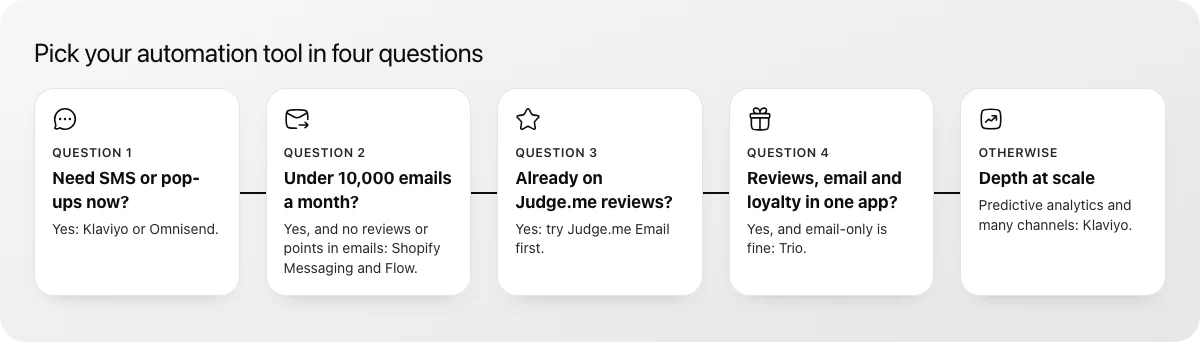
Why this order? SMS and pop-ups are hard requirements: if you need them, half the list drops out at once. Volume comes next because it decides whether a free allowance covers you. Existing apps come third, since the cheapest migration is the one you do not make. Shared data comes last, because it is a real advantage only when you will use review quotes, points balances and loyalty triggers in your emails.
The same logic as a decision table, by store profile, with the email bill for 5,000 contacts receiving six emails each:
| Your store | Start with | Email bill at 5,000 contacts | Watch out for |
|---|---|---|---|
| Email only, one bill, under 10,000 emails a month | Shopify Messaging + Flow | $0 under 10,000 emails, $20 at 30,000 | No review or loyalty data in emails |
| Already on Judge.me reviews, tight budget | Judge.me Email (Free) | about $2.25 | New app; no points program in the Judge.me family |
| Needs SMS and pop-ups now | Omnisend Pro or Klaviyo | above $59 on Omnisend Pro (slider price), $100 on Klaviyo Email | SMS billed per message or credit on top |
| Several channels and a dedicated marketer | Klaviyo Marketing | $130 | Loyalty is a separate app and a separate bill |
| Team already on Mailchimp, sells on several platforms | Mailchimp Standard | calculator price | No flows on Free, 4-step flows on Essentials |
| Reviews, email and VIP tiers in one app | Trio Growth (ours) | $79, reviews and loyalty included | No SMS, no pop-ups, limited segments |
Shopify email automation tools and marketing workflows: a 14-day trial test
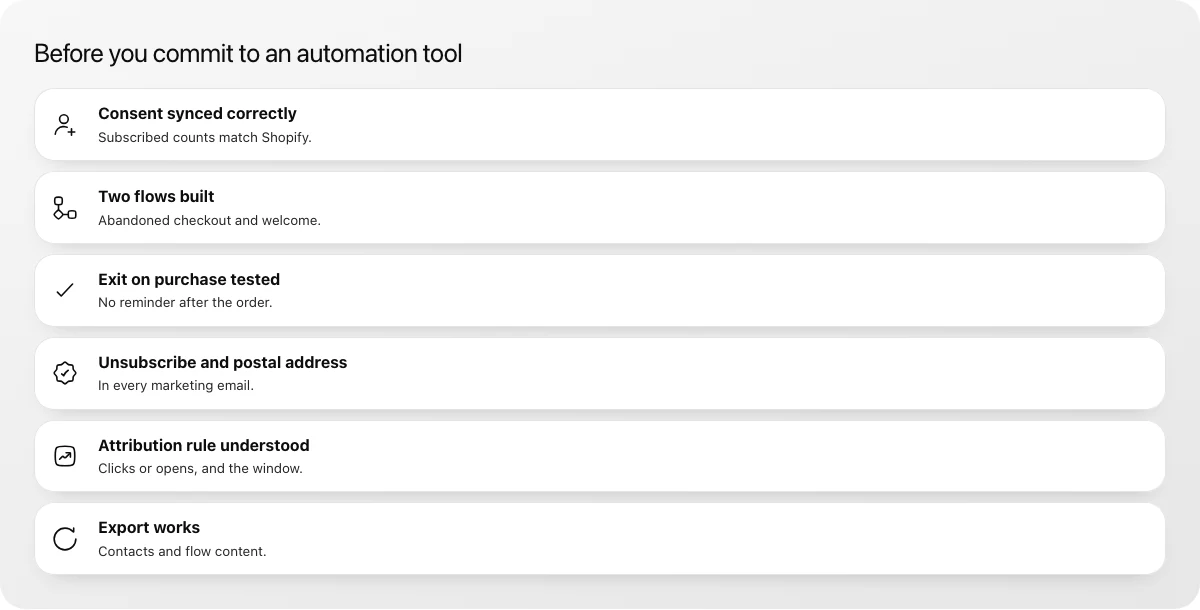
Most of these tools have a free plan or a trial: 14 days on Trio's paid plans, Mailchimp's paid plans and Smile.io Essential, 15 days on Judge.me Awesome. Use it to test the workflows you will actually run, not the template gallery.
- Day 1, sync and consent. Install, import customers and count how many arrive as subscribed. If that number is far from what Shopify shows, stop and find out why before you send anything.
- Day 2, two flows. Build abandoned checkout and a welcome series. Our abandoned cart email guide covers timing, number of reminders and copy.
- Day 3, a test customer. On your phone, start a checkout, leave, wait for the reminder, then buy. Confirm the next reminder never arrives. Without a working exit on purchase, an automation emails people who already paid.
- Day 4, legal basics. Every marketing email needs a working unsubscribe link and your postal address. The FTC's CAN-SPAM compliance guide requires a valid physical postal address and opt-outs honored within 10 business days.
- Days 5 to 12, real traffic. Read the attribution rule: does a click count, or an open too, and over how many days? Compare tools on the same rule, or you compare nothing.
- Day 13, the exit door. Export your contacts and copy your flow content. If leaving is hard now, it will be harder in a year.
- Day 14, decide. Price the tool at your expected list size in 12 months, not at today's list.
Setting up marketing automation workflows in Trio
If the decision path led you to an all-in-one, here is what setup looks like in Trio. The automations live in one list, each scenario with its own switch.

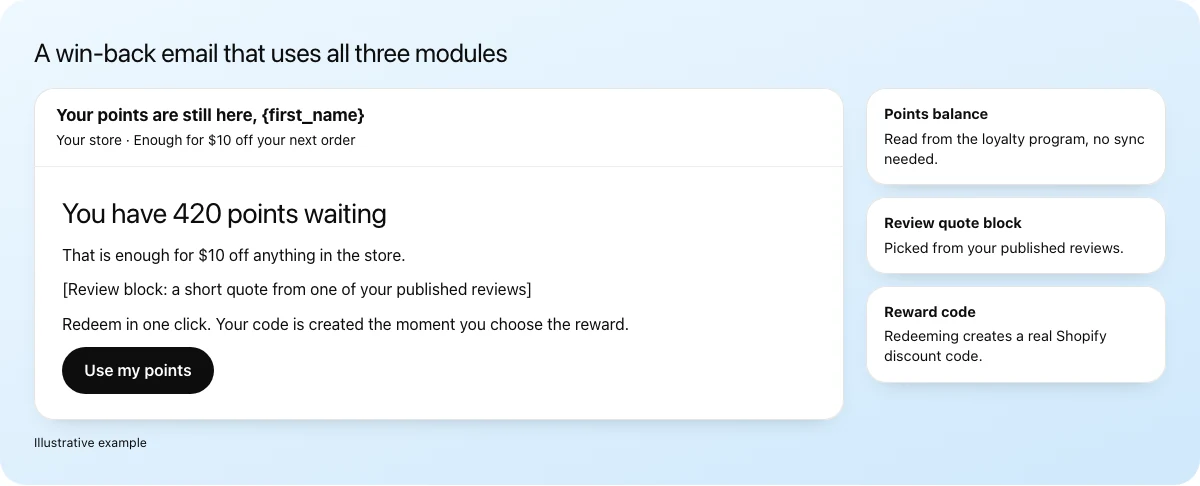
The difference shows up inside the email. A win-back email can carry the customer's points balance, a quote from your product reviews and a reward from your loyalty program, with no integration to maintain.
Final verdict: the best marketing automation tool is the one priced for your next 12 months
There is no universal winner, only a fit:
- Small list, email only, one bill: Shopify Messaging with Flow.
- SMS, pop-ups and deep segmentation: Klaviyo for depth, Omnisend for price.
- Large list on a tight budget: Judge.me Email, especially if you already use Judge.me reviews.
- Reviews, email and loyalty on one customer record: Trio, our product, provided email-only works for you.
Whatever you pick, run the 14-day test, price it at next year's list size and add up the whole stack. If email is your main question, our comparison of the best email marketing tools for Shopify stores goes deeper on that channel alone.
Frequently asked questions
- What is the best marketing automation tool for ecommerce?
- There is no single winner. For a Shopify store starting out, Shopify Messaging plus Shopify Flow is the simplest low-cost option, and Judge.me Email Marketing is the cheapest once your list is large. Klaviyo is the deepest platform for multichannel work at scale, Omnisend is strong on pop-ups and SMS, and an all-in-one app such as Trio (our product) fits stores that want reviews, email and loyalty in one place without SMS.
- What is the best email automation app for Shopify?
- Pick by list size and channels. Shopify Messaging includes 10,000 free emails a month and bills on your Shopify invoice. Klaviyo and Omnisend add SMS, pop-ups and AI segmentation. Judge.me Email Marketing bills per email sent, with 15,000 free emails a month, which makes it very cheap for large lists.
- Does Shopify have built-in marketing automation?
- Yes. Shopify Messaging creates email and SMS marketing automations from the Shopify admin, and Shopify Flow is a free app on the Basic, Grow, Advanced and Plus plans. Shopify points you to Flow when an automation needs custom logic or a third-party app.
- How much does marketing automation cost for an ecommerce store?
- Anywhere from $0 to a few hundred dollars a month, and your list size decides. For 5,000 contacts receiving six emails each per month, our math gives about $2 on Judge.me Email, $20 on Shopify Messaging, $79 on Trio Growth and $100 on Klaviyo's Email plan, using list prices checked on November 25, 2026.
- Is Klaviyo worth it for a small Shopify store?
- It is if you will use what you pay for, such as SMS, predictive analytics, AI segments and forms. The free plan covers 250 active profiles and 500 emails a month, and the Email plan costs $30 a month at 1,000 profiles. If you only need a welcome series and an abandoned checkout reminder, cheaper tools do that job.
- Which automations should an ecommerce store set up first?
- Start with the two flows closest to a purchase, abandoned checkout and a welcome series. Add post-purchase and the review request next, then win-back, birthday and loyalty reminders. Every tool on this list can run the first two, though Mailchimp and Trio need a paid plan for automations.
- Do I need SMS in my marketing automation tool?
- Not to start. Email covers the core flows at a lower cost per message, and every tool here that offers SMS bills it per message or per credit pack. Add SMS when you have a time-sensitive use case and subscribers who opted in to texts. Trio is email-only today.
- Can one app handle reviews, email and loyalty?
- Yes. Trio, our product, combines all three on shared customer data, so an email can show a points balance and quotes from reviews. Klaviyo includes reviews in its plans but has no native loyalty program, and Growave combines loyalty and reviews but is not an email marketing platform.
- Are HubSpot or ActiveCampaign good for ecommerce marketing automation?
- They are general-purpose platforms that appear in most roundups for this search. We left them out because this guide only compares tools whose Shopify pricing and flows we could verify on official pages. If you already use one of them, run the 14-day trial test from this guide on its Shopify sync before you commit.
- How do I switch marketing automation tools without breaking anything?
- Rebuild your flows in the new tool before you turn anything off, and test each path with a test customer. Then switch off the old flows one at a time so no shopper gets two abandoned checkout emails. Check that marketing consent and unsubscribes came across before you send the first campaign.
Related articles
Six Shopify email platforms compared on real monthly cost at 1,000 to 25,000 contacts, plus a decision table and a switching checklist. Find your fit …
November 25, 2026CompareBest email marketing software in 2026: 6 tools for online stores, priced by how you sendCompare the best email marketing software for online stores by pricing model: what 6 tools cost at 2 to 12 emails per contact, plus their limits. Pick…
November 25, 2026CompareBest Free Product Review App for Shopify: Top Picks 2026We compared the free plans of 7 Shopify review apps: order caps, photo reviews, Google stars and the real cost once you grow. Find the right one for y…
November 25, 2026