


Best Review App for Shopify: 7 Apps Compared on Real Cost (2026)

- Judge.me is the best free review app for most Shopify stores. Photo and video reviews, review requests and rich snippets come with no order cap, and the paid plan is $15 a month flat.
- Order-based pricing is the hidden cost. At 1,000 orders a month, entry paid plans range from $15 to about $200 depending on the app, so check the cost table before you pick.
- Trio, our app, fits stores that also need email marketing and a loyalty program. All three modules come in one plan, priced by email contacts instead of orders.
There is no single best review app for Shopify. There is a best app for your order volume, for how much your products depend on photos, and for the other tools you already pay for. This guide compares seven apps on what they include and, more usefully, on what they cost at 100, 500, 1,000 and 2,500 orders a month, using the public prices listed on November 25, 2026.
Disclosure first: we make Trio, one of the seven apps. We say where competitors beat it, including free plans that do more than ours. Shopify retired its old free Product Reviews app: its Help Center now covers Shop product reviews, which live in the Shop app, so a review widget on your own theme needs a third-party app. If you are new to the topic, read our complete guide to Shopify product reviews first, then come back to pick a tool.
Quick picks: the best Shopify review app for each type of store
- Best free plan: Judge.me. Unlimited reviews, photo and video reviews, review requests and Google rich snippets with no order cap.
- Best for photo-led brands: Loox. Photo-first widgets and discounts for photo reviews, free up to 500 orders.
- Best flat price at any volume: Junip. No order or request limits on any plan, from $0 to $299 a month.
- Best for retail syndication: Yotpo Reviews. Google Seller Ratings and syndication to retailers, with prices that scale by orders.
- Best for a sales-led platform: Okendo. Reviews, loyalty, referrals, quizzes and surveys, with most add-ons priced on request.
- Best for integration-heavy stacks: Stamped. Klaviyo, Attentive, Omnisend and Gorgias integrations plus free review migration, but no free plan.
- Best if you also need email and loyalty: Trio. Reviews, email marketing and a loyalty program in one app, with photo reviews from $29 a month.
If a free plan is the only thing that matters to you, our shortlist of the best free product review apps goes deeper on free-plan limits.
How we compared the best product review apps for Shopify
We read each app's Shopify App Store listing and official pricing page on November 25, 2026. Ratings and review counts come from the App Store on that date. Where the App Store and the vendor's own site disagree, we say so in the app's section. We did not measure conversion lift for any app, ours included, so you will not find invented percentages here. Fera, Reviews.io and Trustoo appear in other roundups; we left them out because we did not verify their current plans on the check date.
The research on why reviews matter is older and independent. Northwestern University's Spiegel Research Center study on online reviews is still the most cited source:
The last number is the one to remember when you choose a tool. Purchase likelihood peaks below a perfect score, so a perfect 5.0 is not the goal. You want an app that collects every rating, including the three-star ones, and makes it easy to answer them in public.
We scored every app on six questions:
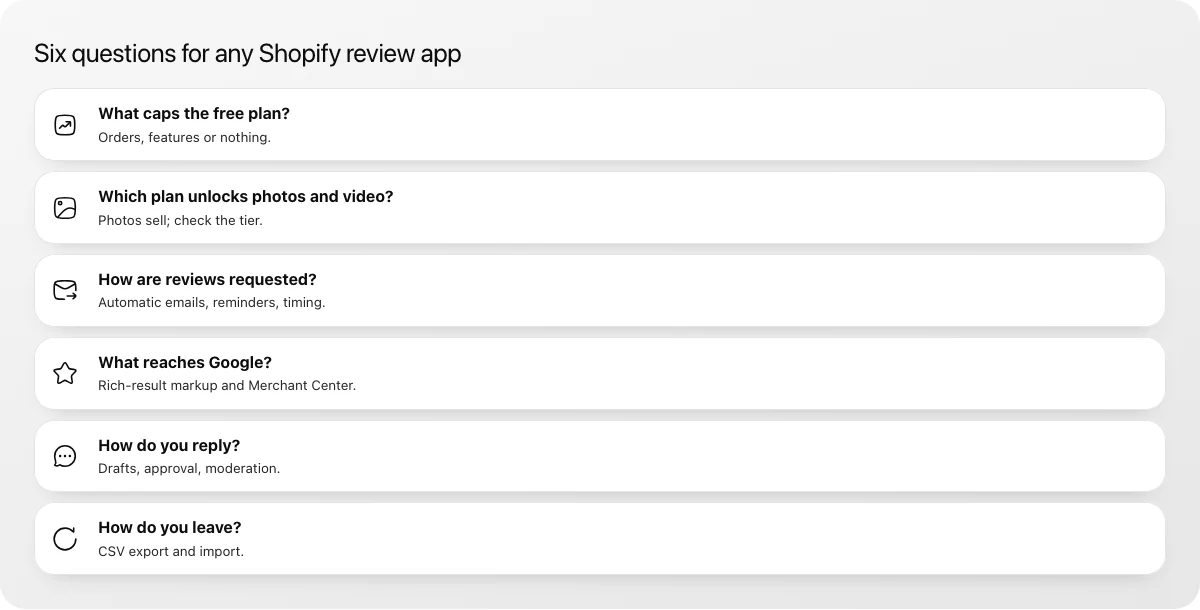
Two of these deserve a word. Google is where reviews keep working after the visit: our guide to getting star ratings in Google Shopping explains the markup and the Merchant Center feed. Replies are where most stores fall behind, which is why AI drafts are now common; see how to automate review replies without sounding like a robot.
Best Shopify apps for product reviews, side by side
Here are the four most searched apps against the criteria above. Trio is highlighted because it is ours, not because it wins every row.
| Feature | Trio (our app) | Judge.me | Loox | Yotpo Reviews |
|---|---|---|---|---|
| Free plan | ✓ | ✓ | ✓ | ✓ |
| Free plan limit | Unlimited text reviews, 250 email contacts | No order cap | 500 orders | 50 orders a month |
| Photo reviews on the free plan | ✗ | ✓ | ✓ | ✗ |
| Automatic review requests on the free plan | ✗ | ✓ | ✓ | ✓ |
| Google rich snippets from | Starter, $29/mo | Free | Free | Starter, from $15/mo |
| Video reviews from | Growth, $79/mo | Free | Convert, $49.99/mo | Starter, from $15/mo |
| AI review summary from | Starter, $29/mo | Awesome, $15/mo | Convert, $49.99/mo | Pro on the App Store, Premium on yotpo.com |
| Syndication to Meta or TikTok Shop | ✗ | Awesome plan | Convert plan | TikTok and retailers |
| Built-in loyalty program | ✓ | ✗ | ✗ | Separate app |
| Built-in email marketing | ✓ | Separate app | ✗ | Not in this app |
| Price grows with | Email contacts | Nothing (flat) | Orders | Orders |
Read the free-plan rows carefully. On Trio's free plan, customers can leave text reviews from the on-site form, but automatic review requests and photo reviews start on Starter. Judge.me, Loox and Yotpo all send requests for free, within their order caps. Where Trio pulls ahead is the bottom of the table: reviews, email and loyalty share one customer record and one bill.
What each review app really costs as your orders grow
Most review apps charge by monthly orders, so the entry price is not your price. A plan that looks cheap at launch can cost several times more after a good holiday season. Start with how each app charges:
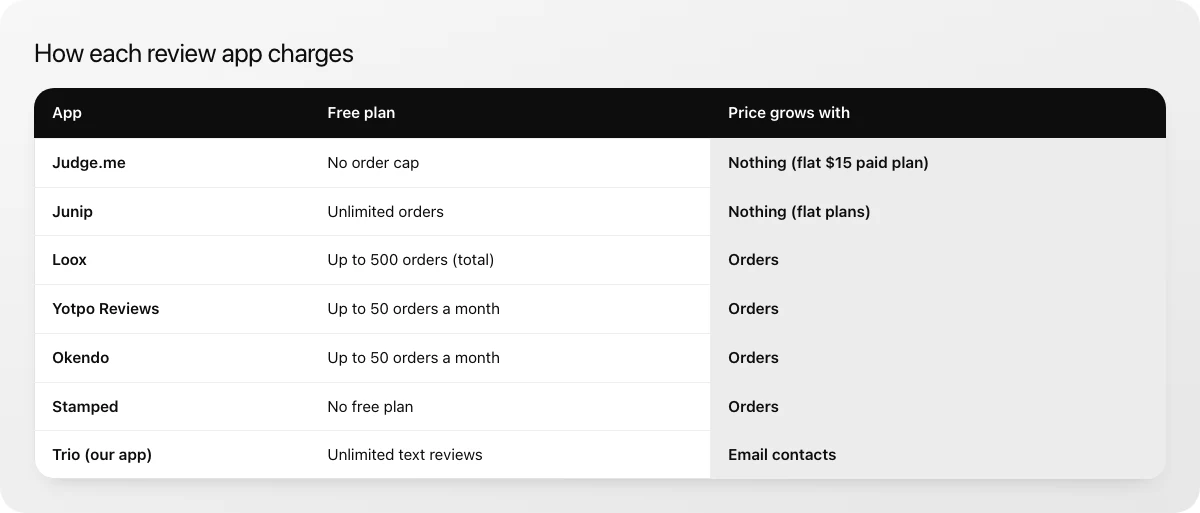
Then the math. This table shows the monthly price of each app's entry paid plan that covers a given order volume, billed monthly, in USD, before tax:
| App and paid plan | 100 orders/mo | 500 orders/mo | 1,000 orders/mo | 2,500 orders/mo |
|---|---|---|---|---|
| Judge.me (Awesome) | $15 | $15 | $15 | $15 |
| Junip (Core) | $29 | $29 | $29 | $29 |
| Stamped (Reviews) | $23 | $99 | $99 | $199 |
| Okendo (Essential, Growth, Power) | $19 | $119 | $119 | $299 |
| Yotpo Reviews (Starter, then Pro) | $24 | $89 | $129 | $329 |
| Loox (Convert, then Unlimited) | $49.99 | $99.99 | $199.99 | $299.99 |
How we got there:
- Loox: the App Store listing says Convert includes 300 orders, then $50 for each additional 300. At 1,000 orders that is $49.99 plus 3 × $50. At 2,500 orders the same math reaches $449.99, so the $299.99 Unlimited plan is cheaper.
- Yotpo: yotpo.com lists Starter tiers up to 1,000 orders. Above that, the next published price is Pro at $329 for up to 3,000 orders. Yotpo's App Store listing also warns that some charges may be billed outside the Shopify invoice.
- Okendo: Essential covers 200 orders, so a 500-order store jumps to Growth at $119.
- Annual billing lowers several of these prices: Yotpo shows savings of 20 to 25%, Okendo 8 to 11%.
Trio is not in the table because order volume does not set its price. Starter is $29 a month for up to 1,000 email contacts, Growth $79 for 5,000 and Scale $199 for 25,000, with unlimited reviews on every paid plan. Annual billing gives two months free. Details are on Trio's pricing page.
The stack math: when you also pay for email and loyalty
A review app is rarely the only bill. A common stack for a store with about 1,000 subscribers and under 500 orders a month looks like this, using each vendor's public prices:
- Judge.me Awesome: $15 a month.
- Klaviyo Email plan for 1,000 active profiles: $30 a month.
- Smile.io Essential loyalty, up to 500 orders: $15 a month.
That is $60 a month across three apps, against $29 for Trio Starter with 1,000 contacts. The stack can be cheaper, though: swap Klaviyo for Judge.me's own email app, free up to 15,000 emails a month, and the same three jobs cost $30, with more email volume than Trio Starter's 10,000 emails. To be fair to that stack, Klaviyo does far more in email (SMS, predictive analytics, send-time optimization) and Smile.io supports Shopify POS on every plan. Neither Smile.io Essential nor Trio Starter includes VIP tiers: Smile.io starts them on its $199 Growth plan, and Trio on its $79 Growth plan. So the honest test is not the sticker price: it is whether you want one customer record and one bill, or the deepest tool in each category. If you only need reviews, a dedicated review app is the cheaper choice.
The 7 best reviews apps for Shopify, one by one
1. Judge.me: the best free review app
Best for: almost any store that wants strong reviews for little or no money. App Store rating: 5.0 from 50,788 reviews.
The Forever Free plan has unlimited product and store reviews, unlimited photo and video reviews, review widgets, carousels, rich snippets and imports from other apps and marketplaces, with no order cap. The Awesome plan is $15 a month flat. Judge.me's pricing page says "$15 per month is the most you can ever pay us". Awesome adds AI replies, summaries and translations, auto-reminders, coupons, 130+ integrations including Klaviyo and Gorgias, and syndication to Google Shopping, Meta and TikTok Shop. Widgets and emails come in 38 languages.
Limits: there is no loyalty points program, only coupons and referrals tied to reviews. Email marketing is a separate app, Judge.me Email Marketing, launched on July 14, 2026, with 15,000 free emails a month and then $0.15 per 1,000.
2. Loox: best for photo-first brands
Best for: fashion, beauty and home brands whose shoppers buy from photos. App Store rating: 4.9 from 10,203 reviews.
The free Beginner plan covers up to 500 orders, which loox.app lists as total orders rather than a monthly allowance, with review request emails and reminders, discounts for photo reviews, 17+ widgets, rich snippets and Shop app syndication. Convert, at $49.99 a month plus order overage, adds AI sorting, summaries, translations and replies, video reviews, reviews on bundles, referrals and syndication to Google Shopping, Meta and TikTok Shop. Loox Studio turns reviews into social posts and stories.
Limits: the free plan stops at 500 orders, the overage adds up fast, and the next tier after Convert is $299.99. Loox has no loyalty program and no email marketing tool.
3. Junip: best flat price with unlimited orders
Best for: fast-growing stores that refuse order-based bills. App Store rating: 4.8 from 1,182 reviews.
Every Junip plan has unlimited orders and review requests: Free, Core at $29, Growth at $79 and Premium at $299. Collection is mobile-first. Core adds incentivized reviews, product groups and bundles, and media galleries on the product page. Growth adds syndication to Google Shopping, Meta Shops, TikTok Shop and the Shop app, plus Klaviyo and Postscript integrations. Premium adds the Junip AI Sales Agent, AI summaries, an API and multi-store management. Paid plans have a 7-day trial.
Limits: AI features are Premium-only, and Junip has no loyalty program or email marketing tool.
4. Yotpo Reviews: best for enterprise and retail syndication
Best for: larger brands selling through Google Shopping, retailers or Walmart. App Store rating: 4.8 from 4,627 reviews.
The free plan covers up to 50 orders a month with automatic requests and a template library. Starter runs from $15 to $129 depending on orders and unlocks photo and video collection, rich snippets and Google Shopping ads. Pro runs from $119 to $429 and adds Google Seller Ratings, custom questions and smart sorting. Premium and Enterprise are quoted. Yotpo also offers SMS and email reminders, community Q&A and syndication to TikTok, Walmart and other retailers.
Limits: prices climb steeply with orders, translations and retail syndication sit on custom-priced Premium, and loyalty is a separate app with a separate bill. Our full breakdown of Yotpo pricing walks through every tier.
5. Okendo: best for a sales-led customer platform
Best for: established brands that want reviews, loyalty, referrals, quizzes and surveys from one vendor, with an account team. App Store rating: 4.8 from 1,454 reviews.
The free plan covers 50 orders a month with automated requests, a review rewards engine, Google snippets, review grouping and moderation. Essential is $19 for up to 200 orders. Growth is $119 for up to 1,500 orders and adds AI summaries and keywords, TikTok Shop and a Q&A widget. Power is $299 for up to 3,500 orders and adds review campaigns, an advanced CSS editor and email and SMS integrations.
Limits: the jump from $19 to $119 hits early, okendo.io prices loyalty, referrals and bundles on request, and its platform bundles normally require annual terms.
6. Stamped: best for integration-heavy stacks
Best for: stores already running Klaviyo, Attentive, Omnisend or Gorgias. App Store rating: 4.7 from 3,751 reviews.
Plans are priced only by orders, with the same features at every tier: $23 for 200 orders, $99 for 1,000, $199 for 5,000 and $399 for 20,000. You get in-email review collection, photo and video reviews, Q&A, sync to Google Shopping, Meta and the Shop app, Shopify Flow support and free review migration.
Limits: there is no free plan on the App Store listing, and the Stamped Loyalty app showed as not available on the Shopify App Store when we checked.
7. Trio: best if you also need email and loyalty (our app)
Best for: stores that would otherwise pay for a review app, an email tool and a loyalty app separately. Trio launched on the Shopify App Store on May 8, 2026, so it has a shorter track record than the established apps above.
The free plan includes unlimited text reviews, email campaigns up to 500 emails a month for 250 contacts, and a points program with up to 3 rewards. Starter ($29) adds photo reviews with up to 3 photos each, custom review fields, Google rich-result markup, CSV import from Judge.me, Loox, Yotpo and Trustoo exports, and the automatic review request: by default 7 days after the order, with up to two reminders. Starter also brings Trio AI: reply drafts you approve (50 a month), a review summary with topic chips, and an "ask the reviews" box where shoppers get answers grounded in your reviews. Growth ($79) adds video reviews, custom widget code and AI brand voice.

What makes Trio different is the link between modules. A review can earn loyalty points and trigger a thank-you email, and every email can show the customer's points balance and quotes from your reviews. On Starter and up, when a customer leaves a low rating, Trio can alert you privately and prepare an apology email with a personal discount code for you to approve. See the Trio reviews module, the email marketing module and the loyalty and rewards module.
Limits, plainly: no syndication to Meta, TikTok Shop or the Shop app; no imports from Google, AliExpress, Amazon or Etsy; review text is not translated for shoppers; the request timer starts at the order date, not at delivery; widgets come in 10 languages against Judge.me's 38; and Trio is email-only, with no SMS.
Also worth a look: Klaviyo Reviews and Growave
Klaviyo includes reviews in its own platform. On the Free and Email plans, reviews are capped at 50 orders a month; the Marketing plan, from $25 a month for 500 profiles, removes that cap. It makes sense if your flows already live in Klaviyo. A separate Klaviyo Product Reviews listing is rated 4.8 from 237 reviews.
Growave bundles loyalty, wishlist and reviews. Its free plan is listed at 200 orders a month on the App Store and 100 in the growave.io FAQ. Video reviews, AI summaries and Google Shopping reviews start on Growth at $199 a month.
Choosing the best review app for Shopify: a decision table
Match your situation to a starting point, then run the 30-minute test in the next section before you commit.
| If your store... | Start with | Why | Watch out for |
|---|---|---|---|
| Has under 500 orders a month and a tight budget | Judge.me Free | Photos, video and rich snippets for $0 | Reminders and AI need Awesome ($15) |
| Sells visual products and wants photo-first widgets | Loox | Photo-first design, photo-review discounts | Overage beyond 300 orders on Convert |
| Grows fast and wants a bill that does not scale | Junip or Judge.me | Flat prices at any volume | Junip's AI is Premium-only ($299) |
| Sells through Google Shopping, retailers or Walmart | Yotpo Reviews | Seller Ratings, retail syndication | Price climbs with orders |
| Wants reviews, loyalty and quizzes with an account team | Okendo | One sales-led platform | Loyalty pricing is not public |
| Runs Klaviyo, Attentive or Gorgias | Stamped or Judge.me Awesome | Deep integrations | Stamped has no free plan |
| Pays for separate email and loyalty apps, or plans to | Trio | Three modules, one bill, priced by contacts | No Meta or TikTok syndication |
| Already runs every flow in Klaviyo | Klaviyo Reviews | Reviews next to your flows | 50-order cap below the Marketing plan |
Test any review app in 30 minutes before you commit
Feature lists all look alike. A short test on your own store shows the differences that matter: how the widget looks on your theme, what Google sees and what your customers receive.
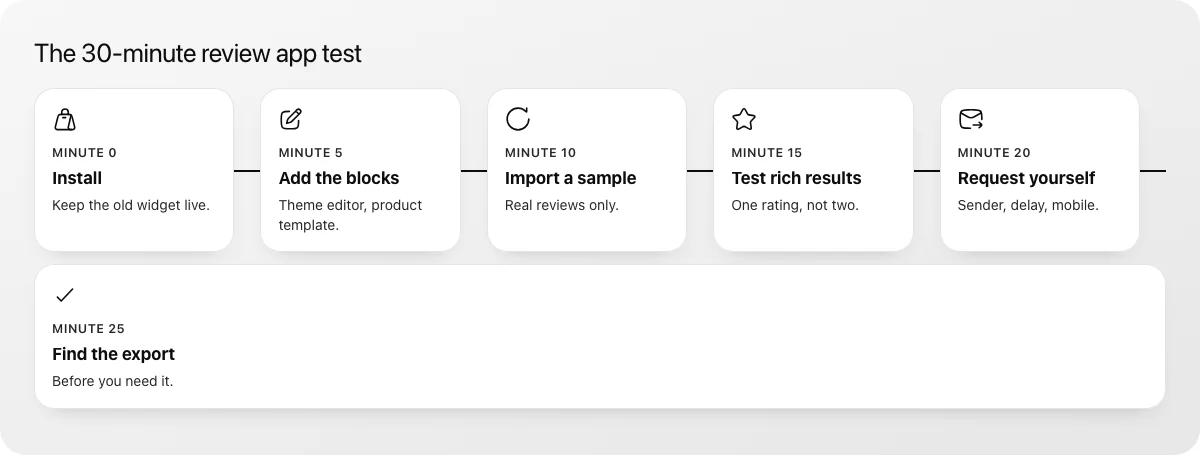
- Install the app and keep the old widget live. Use the free plan or the trial: 14 days on Loox, Okendo Essential and Trio's paid plans, 15 days on Judge.me Awesome, 7 days on Junip.
- Add the blocks. In Shopify, go to Online Store, then Themes, then Customize. Open a product template, click Add block and pick the app's review block under Apps. Add the star badge near the product title the same way, save, and check the page on a phone.
- Import a sample. Upload a small CSV of your real reviews, only ones your own customers wrote about that product. Check that dates, names and photos survived.
- Test rich results. Run Google's Rich Results Test on one product URL. You want exactly one AggregateRating. Two usually means the old app or your theme still outputs markup. Google's review snippet guidelines also require the markup to match the reviews visible on the page.
- Send yourself the request. Check the sender name, the delay, whether the stars sit inside the email, and how it reads on mobile. Compare the wording with these review request email examples.
- Find the export. Locate the CSV export before you need it. An app you cannot leave is a risk, whatever it costs today.
Most demos show a wall of five-star reviews. Look at the widget at two stars too, because that is where your reply does the selling. Drag the slider:
Arrived fast, and it looks even better in person.
Example product · Illustrative example, not a real reviewOne legal check belongs in the test. If an app offers discounts or points for reviews, make sure you reward every review, not only the good ones. The FTC's final rule on fake reviews and testimonials, announced in August 2024, bans incentives conditioned on sentiment, fake reviews, undisclosed insider reviews and review suppression.
How to switch review apps without losing your stars
Switching is safer than most merchants fear, as long as you keep the old app running until the new one is verified. The order matters:
- Export before you uninstall. Download the full CSV while the old app is installed; photo links may stop working afterwards.
- Import, then check three numbers: compare review count, average rating and photo count on three products, old widget against new.
- Swap the widgets: remove the old app's blocks and app embeds in the theme editor, then add the new ones.
- Uninstall last, then rerun the Rich Results Test to confirm only one rating source remains.
- Watch the collection stars. Themes often read Shopify's standard rating metafields for collection-page stars. Trio writes
reviews.ratingandreviews.rating_count, so those stars keep working after a move.
Our step-by-step guide to importing reviews into Shopify includes a copyable CSV template. If you are leaving Judge.me, follow the Judge.me migration walkthrough.
The short version: start with Judge.me if you want the most for free, Loox if photos sell your product, Junip if you want a flat bill, and Yotpo or Okendo if you need enterprise reach. Choose Trio if you would rather run reviews, email and loyalty from one app and one customer record. Whatever you pick, test it on your own store first.
Frequently asked questions
- What is the best review app for Shopify?
- For most stores, Judge.me. Its free plan includes photo and video reviews, review requests and Google rich snippets with no order cap, and its paid plan is $15 a month flat. Pick Loox for photo-first widgets, Yotpo for retail syndication, or Trio if you also want email marketing and loyalty in the same app.
- What is the best free review app for Shopify?
- Judge.me has the most generous free plan we found, with unlimited reviews, photo and video reviews and rich snippets and no order limit. Junip's free plan also has no order cap. Loox is free up to 500 orders, listed as total orders rather than monthly, and Yotpo and Okendo are free up to 50 orders a month.
- Does Shopify have its own product reviews app?
- Not for your storefront anymore. Shopify retired its old free Product Reviews app, and its Help Center now covers Shop product reviews, which Shop customers leave in the Shop app after delivery and which appear in the Shop app. To show a review widget on your own product pages, stores use a third-party app. If you kept an export from the old app, an app with CSV import can bring those reviews back.
- Is Judge.me better than Loox?
- It depends on your volume and your products. Judge.me is cheaper, free with no order cap or $15 a month flat. Loox is built around photo-first widgets and is free up to 500 orders, then $49.99 a month with charges that grow with orders. If photos drive your sales and budget is not tight, test Loox. Otherwise start with Judge.me.
- How much does a Shopify review app cost?
- From $0 to several hundred dollars a month. Flat-priced plans run from $15 (Judge.me Awesome) to about $300 (Junip Premium at $299, Loox Unlimited at $299.99). Order-based apps rise with volume. At 1,000 orders a month, their entry paid plans range from $99 (Stamped) to about $200 (Loox), based on public prices checked in November 2026.
- Can I switch review apps without losing my reviews?
- Yes. Export your reviews as a CSV before you uninstall the old app, import them into the new one, and check counts and averages on a few products before you swap widgets. On Starter and up, Trio imports export files from Judge.me, Loox, Yotpo and Trustoo, keeping ratings, text, dates and photos.
- Do review apps help with SEO and Google stars?
- They add product review structured data that can make your star ratings eligible to show in Google results, and some also send reviews to Google Merchant Center. Google decides whether stars appear, and the markup must match the reviews visible on the page.
- Can I run two review apps at the same time?
- Avoid it on the same product pages. Two apps mean two widgets and often two sets of rating markup, which confuses shoppers and search engines. Run both only during a short migration, with a single widget visible.
- Is it legal to offer a discount in exchange for a review?
- In the US you can reward reviews as long as the reward does not depend on the review being positive or negative. The FTC rule announced in August 2024 bans sentiment-conditioned incentives, fake reviews and undisclosed insider reviews. Rules differ in other countries, so check where you sell.
- Do review apps slow down a Shopify store?
- Any app that loads a widget adds code to the page. Measure a product page with PageSpeed Insights before and after you add the widget, and remove blocks you do not use. Trust your own test on your own theme more than any speed claim, including ours.
Related articles
Six Shopify email platforms compared on real monthly cost at 1,000 to 25,000 contacts, plus a decision table and a switching checklist. Find your fit …
November 25, 2026CompareBest email marketing software in 2026: 6 tools for online stores, priced by how you sendCompare the best email marketing software for online stores by pricing model: what 6 tools cost at 2 to 12 emails per contact, plus their limits. Pick…
November 25, 2026CompareBest Free Product Review App for Shopify: Top Picks 2026We compared the free plans of 7 Shopify review apps: order caps, photo reviews, Google stars and the real cost once you grow. Find the right one for y…
November 25, 2026