


Ecommerce Retention by Industry: Complete Guide (2026)

- In Bluecore's 2025 benchmarks, retention ranges from 19.1% for jewelry to 41.2% for health and beauty. How often your product runs out matters more than your category label.
- Sort your store into one of four archetypes (replenishment, collection, durable, gift) and build the lever that fits it first.
- Time reorder reminders with supply days minus a buffer, counted from the order date, and set win-backs from your own repeat data.
Retention advice usually comes as one list: send a welcome email, start a loyalty program, ask for reviews. Then a supplement brand and a furniture brand follow the same list and get very different results. A customer who runs out of capsules every 30 days and a customer who buys a sofa once a decade do not come back for the same reasons, and they should not get the same emails.
This guide covers ecommerce retention by industry: what the published benchmarks really measure, a framework of four retention archetypes, a reorder formula you can copy, and playbooks with timings for 12 verticals. Our Shopify customer retention guide covers the measurement steps and the toolkit every store needs. This page is about what changes from one industry to the next.
Ecommerce retention by industry: retention rate benchmarks and what they measure
The most cited recent breakdown comes from Bluecore's 2025 Customer Growth Benchmarks Report, reproduced in Shopify's guide to retention rates by industry. Bluecore tracked customer retention across seven retail verticals and found a combined rate of 27.4%.
Here is the full table, in the order of the figures:
| Vertical (Bluecore, 2025) | Average customer retention rate |
|---|---|
| Jewelry and accessories | 19.1% |
| Home goods | 21.4% |
| Footwear | 22.2% |
| Sports and hobbies | 27.8% |
| Apparel | 31.7% |
| Department stores | 36.2% |
| Health and beauty | 41.2% |
The pattern matters more than any single number. The more often a product gets used up, the higher the rate. Health and beauty products run out. Jewelry, shoes and home goods do not. The 95% figure, quoted in the same Shopify article, explains where to focus: the second order is the one that changes a customer's behavior, so every playbook below is built to earn it.
Why repeat purchase rate by industry lists disagree
Search for retention rates and you will find figures from under 10% to over 60% across categories, and two lists rarely agree on the same one. Most of the gap comes from definitions, not from stores. Before you compare yourself with any figure, check which of these it is:
- Retention rate: customers at the end of a period, minus the new customers acquired during it, divided by the customers at the start. It moves a lot with the length of the period.
- Repeat customer rate: the share of all customers who have ever placed two or more orders. It grows with the age of the store.
- Returning customer rate: in Shopify, the share of customers in a date range whose order history already included an earlier order.
- Repeat purchase intent: a survey answer ("would you buy again?"), not observed behavior. It usually runs higher than real repeat rates.
A 90-day window and a 12-month window give very different results for the same store. So do a store that launched last year and one that has sold for ten. Use benchmarks as a sanity check, then compare yourself with your own numbers from last year, measured the same way.
Four retention archetypes: match the strategy to the purchase cycle
Industry labels hide the thing that drives retention: when, and why, a customer needs you again. Almost every Shopify store fits one of four archetypes. Some sit across two: a pet store sells food and toys, and a baby store sells diapers and strollers.
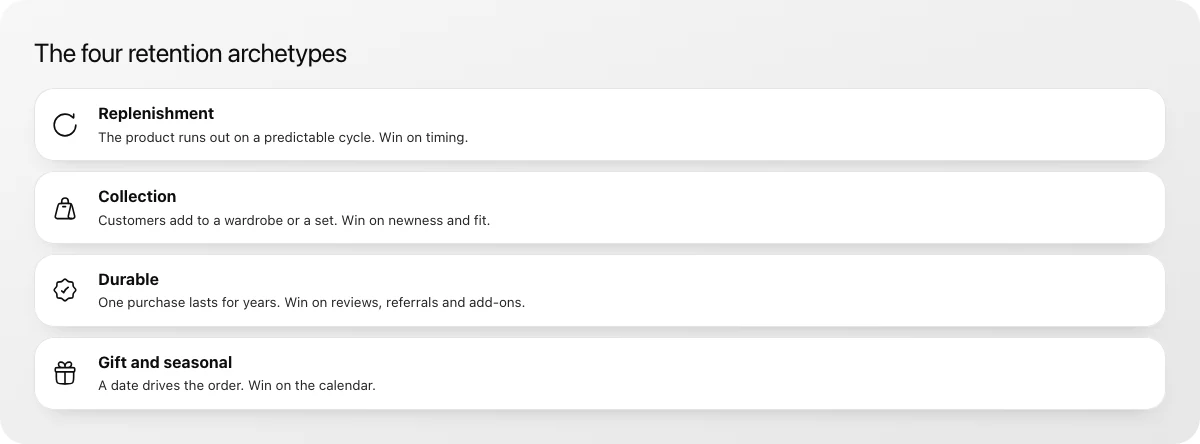
| Archetype | Typical industries | What brings the customer back | Metric to watch | The classic mistake |
|---|---|---|---|---|
| Replenishment | Supplements, coffee, pet food, skincare, diapers | The product runs out | Days to second order | A win-back sent long after they bought elsewhere |
| Collection | Apparel, footwear, jewelry, home decor | Something new that fits what they own | Second-order rate within 180 days | Weekly promos with nothing new in them |
| Durable | Furniture, mattresses, bikes, appliances | Accessories, care, a friend who asks | Referral orders and review rate | "Time to restock" emails for a sofa |
| Gift and seasonal | Gift boxes, wine gifts, holiday decor, swimwear | A date in the calendar | Year-over-year return rate | Treating the buyer as the user |
Running the wrong archetype's playbook costs more than running none. A durable-goods store that emails every two weeks wears out its list. A coffee roaster that waits 90 days to send a win-back has already lost the customer to the supermarket shelf. Build the lead lever first, then add the other two.
Replenishment email timing: your repeat window and the reorder formula
Two numbers tell you more than any industry average:
- Time to second order: the median number of days between a customer's first and second order.
- Second-order rate: the share of first-time customers who come back for a second order within a fixed window. 180 days works for most stores; use 12 months for jewelry, furniture and gifts.
Shopify Admin has the reports you need: Returning customers, New vs returning customers, Customer cohort analysis and RFM customer analysis. The Shopify Help Center describes what each customers report shows. Our Shopify customer retention guide walks through exporting the Returning customers report and computing the median gap in a spreadsheet.
Then add the 75th percentile of the same gap. Past that point, most customers who would come back on their own already have, so that is where a win-back belongs. A median of 34 days and a 75th percentile of 55 days, for example, points to a reorder nudge around day 30 and a win-back around day 60.
The replenishment formula: supply days minus a buffer
For products that run out, you can compute the reminder date before you have any repeat data:
Reminder day = supply days − buffer, counted from the order date.
- Supply days = units in the pack ÷ units used per day, from your label or dosage.
- Buffer = 3 to 5 days, enough to reorder and receive the parcel before the last dose.
Why count from the order date and not the delivery? If both deliveries take the same time, shipping time cancels out. The first parcel arrives S days after the order and the customer starts using it. The reorder needs the same S days to arrive. So the reorder has to be placed about supply days after the first order, whatever S is.
| Product (example) | Pack | Daily use | Supply | Reminder, days after order |
|---|---|---|---|---|
| Capsules | 60 capsules | 2 capsules | 30 days | Day 25 |
| Coffee beans | 12 oz (340 g) | 2 brews of 15 g | 11 days | Day 8 |
| Dry dog food | 30 lb | 0.75 lb | 40 days | Day 35 |
| Face serum | 30 ml | 2 uses of 0.5 ml | 30 days | Day 25 |
| Diapers | 120 diapers | 8 changes | 15 days | Day 12 |
The figures are examples. Use the dose or portion printed on your own label, then check the result against your median time to second order once you have a few months of data. If customers reorder well before the formula says, they are sharing the product or buying more than one unit.
Retention playbooks for replenishment industries
These stores have the highest retention ceiling, which is why health and beauty tops Bluecore's table. They also have the most to lose from bad timing: when the product runs out and no email arrives, the customer buys a substitute wherever they are.
Supplements and vitamins
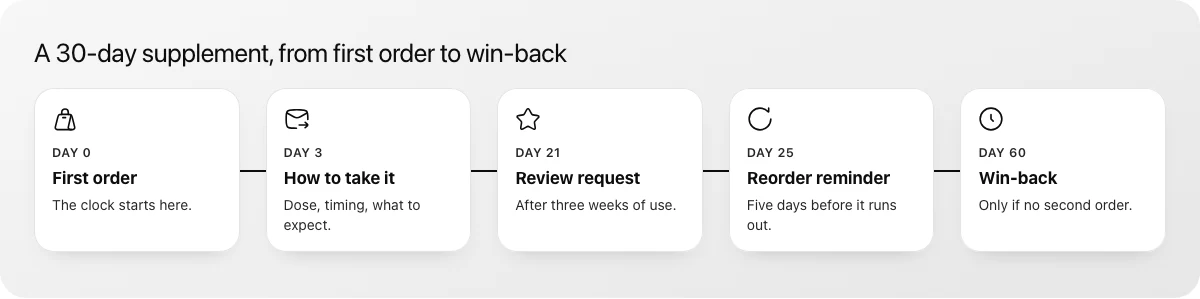
The cycle is printed on the label: 30, 60 or 90 days. Results take weeks, so the customer decides whether to reorder at about the moment they run out. Your emails should help them see progress before that moment.
- Day 2 to 3: a post-purchase email on how and when to take it, and what to expect, limited to claims you can back. Our guide to the post-purchase email has wording for this step.
- Day 21 to 30: the review request, once they have taken it for a few weeks. A review written on day 5 says "arrived fast", not "I sleep better".
- Supply days minus 5: the reorder reminder, with the points balance.
- Day 60 for a 30-day supply: the win-back.
Coffee and tea
Short cycles, a grocery aisle on every corner and customers who like to try new origins. Two levers matter: timing and discovery. A 12 oz bag lasts about 11 days at two brews a day and 22 days at one. If you do not know how much your customers drink, start from your median time to second order.
Make the reminder do double duty. Name the product they bought, then suggest the next origin or blend, so the reorder is also something new. Keep the win-back short: 30 days without an order usually means they are buying coffee somewhere else. For loyalty, small and frequent rewards fit best, such as free shipping or a sample bag that a regular reaches within a few orders.
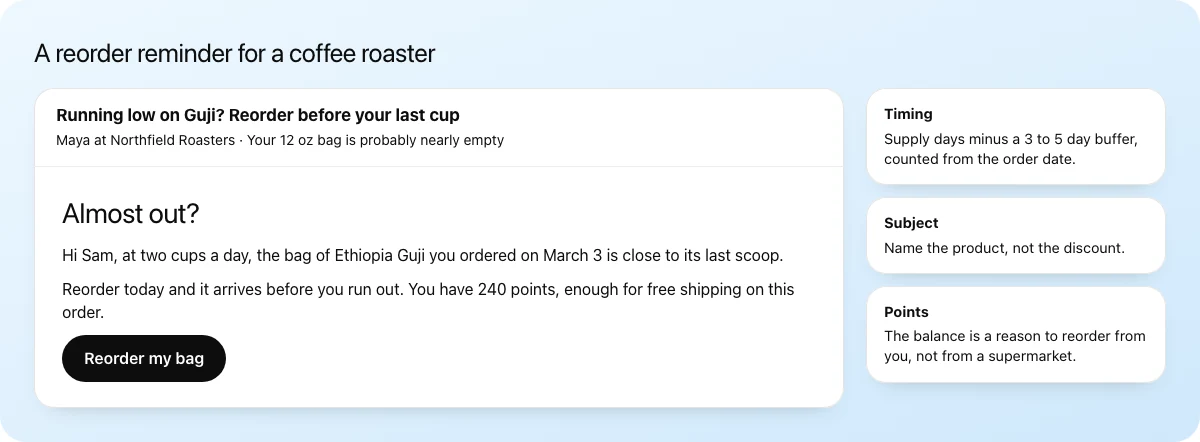
Try the numbers for a coffee customer below. Replenishment stores see the effect of a points program fastest, because the orders come often.
Food, snacks and pantry
Food brands mix replenishment with variety. Consumption varies by household, so pack math is less reliable than your median time to second order. The bigger lever is choice: a new customer who liked one flavor wants to know which one to try next, and reviews per flavor answer that better than your copy.
- Ask for a review 7 to 10 days after the order, while the taste is fresh.
- Use back-in-stock alerts for limited batches and seasonal flavors.
- Run a bonus-points weekend when you launch a new flavor.
- Send the win-back around day 60, with a new flavor rather than a bigger discount.
Pet supplies
Food and litter are pure replenishment. Toys, beds and accessories are impulse or occasion buys. Pet owners buy for a specific animal, so emails that name the pet and its needs feel natural rather than intrusive.
The reorder math comes from the feeding guide on the bag: a 30 lb bag at 0.75 lb a day lasts 40 days, so the reminder goes out around day 35. Pet owners tend to enjoy sharing photos of their animals, so ask for one in the review request. Reward every photo, whatever the rating, and use the best ones in your reorder emails.
Beauty and skincare
Health and beauty leads Bluecore's table at 41.2%. Products run out, routines stick, and a customer who finds something that works rarely switches. Two things decide the second order: whether the product shows results, and whether the next product in the routine is obvious.
- Review timing: skincare results take weeks, so ask about 3 to 4 weeks after the order. For makeup, 7 to 10 days is enough. Our review request email examples show how to word each one.
- Review fields: ask for skin type, shade or concern, so the next shopper can find reviews from people like them.
- Routine cross-sell: a cleanser buyer gets the moisturizer suggestion in the post-purchase sequence, not a random bestseller.
- Reorder: volume ÷ dose, like the serum in the table above.

Baby and kids
Two cycles run at once. Consumables such as diapers, wipes and formula run out fast: 120 diapers at eight changes a day last 15 days. Clothing runs on a size cycle instead. A bodysuit in size 3-6 months bought for a 3-month-old will be outgrown in about three months, so the size label tells you when the next size is due.
Gear such as strollers and car seats is durable: lean on detailed reviews and referrals, because parents ask other parents. Retention in this category also has a horizon, since the child grows out of it. Plan the cross-sell to the next age range before the current one ends.
Retention playbooks for fashion, jewelry, home and seasonal stores
These categories fill the lower part of Bluecore's table, from 19.1% for jewelry to 31.7% for apparel. That is not a failure. A customer who buys a necklace once a year can still be a loyal customer. The goal is a second order within a realistic window, plus referrals in between.
Fashion, apparel and footwear
Apparel retains at 31.7% and footwear at 22.2% in Bluecore's data. What brings a fashion customer back is something new. What stops them is doubt about fit and sizing: "the last one fit, but will this one?"
- Add a fit question to your reviews: runs small, true to size, runs large. It answers the doubt that blocks the second order.
- Ask 10 to 14 days after the order, after delivery and try-on.
- Email on your drop cadence. A new collection is a reason to write; a fixed weekly promo is not.
- Treat a customer whose first order was returned differently: send fit help, not a coupon.
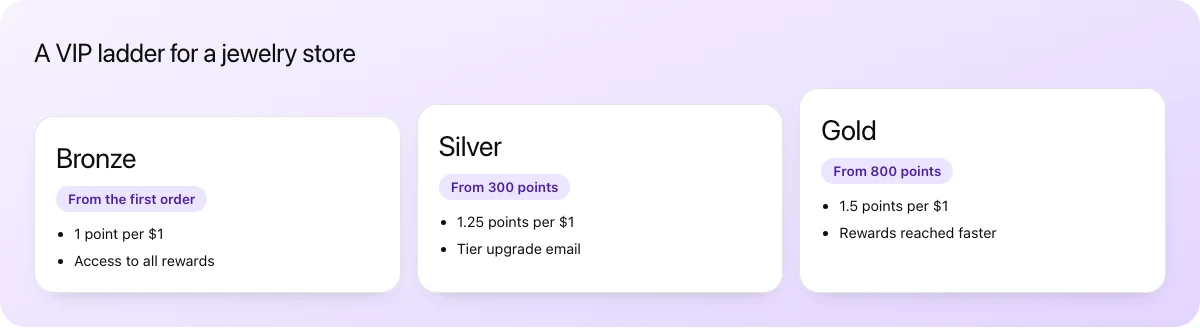
- Use VIP tiers with point multipliers for your best customers, and a 90-day win-back, since fashion buys follow seasons.
Jewelry and accessories
Jewelry has the lowest rate in Bluecore's table at 19.1%. Purchases are rare, often gifts, and the buyer is often not the wearer. Judge yourself on second orders within 12 months, not 30 days.
The levers that work are recognition and reach. A collector who buys three times a year deserves to feel it, which is what VIP tiers do better than points per order. Gifts also create new customers: the person who received the piece. A referral program turns that moment into a first order. Add a "complete the set" email 30 to 60 days after the order (the earrings that match the necklace), and ask for photo reviews of the piece being worn. For program design, see our ecommerce loyalty program guide.
Home goods and furniture
Home goods retain at 21.4% in Bluecore's data. Purchases are considered, delivery can take weeks and order values are high. Retention here means the next room, the matching piece and the friend who visits.
- Review timing: delivery lead time plus two weeks of use. With a four-week lead time, ask around day 40 to 45 after the order.
- Photo reviews in real rooms and answered product questions do the selling for the next buyer. Stars in search results can help too, and our guide to Google product ratings explains how they qualify. Google decides when to show them.
- Care and accessory emails at 30 to 90 days: covers, cushions, a care kit.
- A referral program, because guests see the sofa. Our referral program guide covers rewards and wording.
- A 90-day win-back built around a new collection, not a reorder.
Sports and outdoor
Sports and hobbies retain at 27.8%. The category mixes durable gear with consumables (energy gels, wax, balls, cartridges) and runs on seasons. The calendar is the lever: email before the season starts, when people check their gear, not in the middle of it.
Attach the consumable to the gear. A customer who bought a road bike in March needs tubes and chain lube in May. Ask reviewers what they used the product for (trail or road, beginner or competition), so the next shopper finds the right review. A bonus-points event at the start of each season gives regulars a reason to come back on your schedule.
Wine, spirits and gourmet gifts
This category serves two customers with opposite cycles. Regular drinkers reorder like a replenishment store, and some prefer a club or subscription. Gift buyers come back for dates: Thanksgiving, the holidays, Father's Day, birthdays. Warm up your list a few weeks before each date rather than on the day.
Reviews with tasting notes and food pairings help the next buyer choose. Shipping and promotions for alcohol are regulated state by state, which affects what discounts and rewards you can offer: check the rules where you ship before you build a program.
Special cases: one-product, high-ticket and seasonal stores
- One-product stores (a mattress, an e-bike, a cookware set): the customer will not rebuy soon, so retention means referrals, accessories and reviews that sell to the next customer.
- High-ticket stores: the long consideration phase matters more than repeat orders, so recovering started checkouts is worth more than a loyalty program. Our abandoned cart email guide covers the sequence.
- Seasonal stores (holiday decor, swimwear): retention is annual. Measure year-over-year return rate and email the list before the season, not after it.
- Electronics and gadgets: the device is durable, but filters, cartridges, cases and cables are replenishment. Ask for the review about 14 days after the order, once the device is set up, and time the consumable with the supply formula (a water filter rated for 60 days gets its reminder around day 55).
- Subscription-first stores: retention is churn. Handle skips and cancellations in your subscription app; email covers everyone else.
Retention strategy by industry: the decision table
One table for 12 industries. Review delays are counted from the order date and assume 3 to 5 days of shipping; adjust them to yours. Win-back timings use 30, 60 or 90 days. These are starting points derived from purchase cycles, not measured benchmarks: replace them with your own median and 75th percentile as soon as you have them.
| Industry | Archetype | Lead lever | Review request (days after order) | Win-back | Loyalty mechanic |
|---|---|---|---|---|---|
| Supplements | Replenishment | Reorder reminder | 21 to 30 | 60 days | Points on every order |
| Coffee and tea | Replenishment | Reorder reminder | 7 to 10 | 30 days | Small, frequent rewards |
| Food and snacks | Replenishment and variety | Flavor reviews | 7 to 10 | 60 days | Bonus points on launches |
| Pet supplies | Replenishment | Reorder reminder | 10 to 14 | 60 days | Points for reviews |
| Beauty and skincare | Replenishment | Reviews with skin-type fields | 21 to 28 (skincare), 7 to 10 (makeup) | 60 days | Points on every order |
| Baby and kids | Replenishment and collection | Refill and size-up timing | 10 to 14 | 60 days | Birthday points |
| Fashion and footwear | Collection | Fit reviews | 10 to 14 | 90 days | VIP tiers |
| Jewelry | Collection and gift | Photo reviews, referrals | 14 to 21 | 90 days | VIP tiers and referrals |
| Home and furniture | Durable | Photo reviews, product Q&A | Lead time + 14 | 90 days | Referrals |
| Sports and outdoor | Collection and seasonal | Pre-season emails | 14 to 21 | 90 days | Bonus events at season start |
| Wine and gourmet gifts | Gift and seasonal | Holiday calendar | 10 to 14 | 90 days | Birthday points |
| One-product, high-ticket | Durable | Referrals, accessories | Lead time + 14 | None | Referrals |
Industry rules for review rewards, health claims and alcohol
Retention tactics touch rules that vary by category. Check these before you launch:
- Rewards for reviews, in every industry. Points or discounts for reviews are allowed, but the reward cannot depend on the rating. The FTC's final rule banning fake reviews and testimonials, announced on August 14, 2024, prohibits incentives "conditioned on the writing of consumer reviews expressing a particular sentiment, either positive or negative." It also bars presenting your displayed reviews as all or most of the reviews when negative ones were suppressed. Reward every review the same way, publish the bad ones and reply to them.
- Health claims, in supplements and skincare. When you quote a review in an email or an ad, the claim in it can be treated as yours. The FTC's health products compliance guidance says that a testimonial being an honest opinion is not enough: health claims need competent and reliable scientific evidence. Quote reviews about taste, texture, routine and delivery; leave outcome claims out of your marketing.
- Alcohol. Shipping and promotions are regulated by state. Check which discounts, free products and loyalty rewards you may offer where you ship.
- Email consent, everywhere. Send marketing emails only to customers who accepted email marketing, and keep an unsubscribe link in every one.
Set up your industry playbook in Trio
Trio is our product, so read this section as a description of one option. Trio brings product reviews, email marketing and a loyalty program together in one Shopify app. That matters here because every playbook above uses the three levers in sequence: a review earns points, an email shows the points balance, and an order schedules the next review request.
How the playbooks map to Trio:
- Review request delay. On paid plans, Trio emails a review request a set number of days after each order (7 by default, configurable) and can send up to two reminders. The delay counts from the order date, so add your shipping time to the usage time from the decision table.
- Review fields. Custom review fields (Starter and up) hold the fit question for fashion, skin type for beauty or "used for" in sports. Photo reviews start on Starter and video reviews on Growth.
- Reorder reminders. The post-purchase automation starts at the order and can have several steps, each delayed from the previous one. A how-to email on day 3 followed by a step 22 days later puts the reorder reminder on day 25. Segments use subscriber status, signup source and signup date, plus three loyalty presets (loyal, at-risk and lost members). They do not target by product purchased, so a store with several cycles should time this step for its best seller.
- Win-back. The win-back automation runs after 30, 60 or 90 days of inactivity, which matches the options in the decision table.
- Loyalty. Points per dollar on every order on all plans; points for reviews, birthday points and bonus events such as double points on paid plans. VIP tiers use point thresholds and come with the referral program on Growth and up.
- Limited batches. Back-in-stock and price-drop alerts email subscribers when a product returns or gets cheaper.
- Templates. More than 40 ready-made email designs, with niches including beauty, jewelry, fashion, food, pets, home, kids and sport.
- Measurement. Trio credits revenue to an email or a reward when the customer clicked a Trio email or used a reward code in the 5 days before ordering. It does not track total store revenue, so keep Shopify's reports for the retention rate itself.
The Free plan includes unlimited text reviews, email campaigns up to 500 emails a month for 250 contacts, and a points program with up to 3 rewards. The automations most playbooks need start on Starter. Paid plans start at $29 per month with a 14-day free trial; Trio's pricing page lists every quota.
| What the playbooks need | Trio Free | Trio Starter | Trio Growth |
|---|---|---|---|
| Price per month | $0 | $29 | $79 |
| Automatic review request email | ✗ | ✓ | ✓ |
| Photo reviews and custom review fields | ✗ | ✓ | ✓ |
| Post-purchase, win-back and birthday automations | ✗ | ✓ | ✓ |
| Points program | ✓ | ✓ | ✓ |
| VIP tiers and referral program | ✗ | ✗ | ✓ |
| A/B tests on emails | ✗ | ✗ | ✓ |
A 90-day retention plan for any industry
The order matters more than the tools. Build the lead lever for your archetype first, and measure before and after.
- Days 1 to 14: measure. Pull your median time to second order, the 75th percentile and your second-order rate. Pick your archetype from the table above.
- Days 15 to 30: build the lead lever. A reorder reminder for replenishment, fit reviews and a drop calendar for collection, a review request and referral offer for durable goods, a date calendar for gifts.
- Days 31 to 60: add the second lever. Set the review request delay for your product and a win-back near your 75th percentile.
- Days 61 to 90: add loyalty. Points on every order for replenishment stores, tiers for collection stores, referrals for durable and gift stores.
- Day 90 and after: compare the second-order rate of customers acquired since the changes with the same months last year.
Keep the benchmarks in perspective. A jewelry store at 22% may be doing better than a skincare store at 35%, given what each one sells. The only comparison that tells you whether your retention is improving is your store against itself. For tactics that work in every vertical, see our customer retention strategies, then come back to your row of the decision table and start with its lead lever.
Frequently asked questions
- What is a good customer retention rate for an ecommerce store?
- It depends on what you sell and how you measure it. In Bluecore's 2025 data reported by Shopify, seven retail verticals averaged 27.4%, from 19.1% for jewelry and accessories to 41.2% for health and beauty. Compare yourself first with the same months last year, using the same definition.
- Which ecommerce industry has the highest customer retention?
- The categories where the product runs out. Health and beauty led the seven verticals in Bluecore's 2025 benchmarks at 41.2%. Supplements, coffee and pet food follow the same logic, because the customer has to reorder from someone.
- Why is retention so low for jewelry and home goods?
- People buy them rarely, often as gifts, and one purchase lasts for years. Jewelry and accessories (19.1%) and home goods (21.4%) were the two lowest verticals in Bluecore's data. For these stores, referrals, reviews and a 12-month view of repeat orders matter more than monthly reminders.
- How do I calculate my repeat purchase rate on Shopify?
- Divide the number of customers with two or more orders by all customers who ordered in the same period. Shopify's customer reports include a Returning customers report and a Customer cohort analysis, which give you both the rate and the dates you need to measure the gap between orders.
- When should I send a replenishment email?
- A few days before the product runs out. Take the supply in days (pack size divided by daily use), subtract a 3 to 5 day buffer and count from the order date. If both deliveries take the same time, shipping cancels out, so a 30-day supply gets its reminder around day 25.
- Does a loyalty program work for low-frequency industries like furniture?
- Points per order work poorly when customers buy once every few years. Durable-goods stores get more from a referral program, rewards for photo reviews and accessory or care offers. VIP tiers suit collection categories such as jewelry and fashion, where good customers buy several times a year.
- Should a consumables brand use subscriptions or reminder emails?
- Usually both. A subscription suits customers who use the product at a steady rate, while a well-timed reminder catches everyone who prefers to reorder when they choose. Treat the reminder as the default and the subscription as an option you offer inside it.
- How long should I wait before sending a win-back email?
- Use your own data. Past the 75th percentile of days between first and second orders, most customers who would come back on their own already have, so that is where win-backs start. As a starting point, 30 days suits coffee, 60 days most consumables and 90 days fashion, jewelry and home goods.
- Can I reward customers for reviews in supplements or skincare?
- Yes, if the reward is the same whatever the rating. The FTC's 2024 rule on reviews bans incentives conditioned on a positive or negative sentiment. For health products, also avoid quoting reviews that make health claims in your marketing, because those claims need scientific substantiation.
- What is the difference between retention rate and repeat purchase rate?
- Retention rate measures how many customers from the start of a period are still buying at the end of it. Repeat purchase rate measures the share of customers who have ordered more than once. They answer different questions, which is why published figures for the same industry rarely match.
Related articles
Ecommerce marketing automation, step by step: the 8 flows to build first, timing and exit rules, collision rules, AI and honest measurement. Read the …
November 25, 2026Email marketingEcommerce email marketing: the complete 2026 guide for Shopify storesEcommerce email marketing step by step: which flows to build first, starting schedules, copyable emails, deliverability rules and costs. Start free wi…
November 25, 2026GrowthShopify customer retention: the complete guide (2026)Measure Shopify customer retention with built-in reports, time every email to your repeat window and win the second order. Copy the segments and start…
November 25, 2026